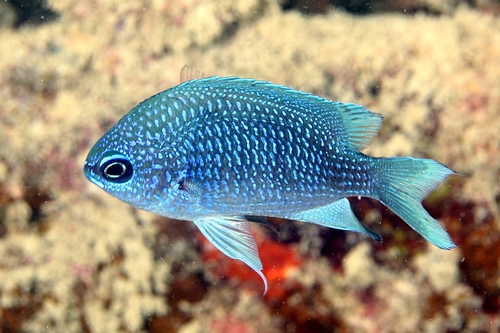
Purple Reeffish
Chromis scotti
A hidden gem of the deep reef, the Purple Reeffish shimmers with electric neon spots and a royal violet body. This small but vibrant fish brings a splash of tropical brilliance to the seaward slopes of the Atlantic.
Quick Identification
Size
Small and compact, typically reaching 2 to 4 inches (5 to 10 cm) in length.
Colors
Deep purple to royal blue body with striking neon blue spots on the head and upper back; some individuals show a subtle yellowish cast on the tail.
Key Features
- Intense violet or deep blue body coloration
- Vibrant neon blue dots concentrated near the eyes and dorsal area
- Oval-shaped profile with a deeply forked caudal fin
- Primarily found on deeper reef slopes rather than shallow flats
When You’ll See Them
Geographic range
Where Does the Purple Reeffish Live?
Native to the Western Atlantic Ocean, the Purple Reeffish is a staple of tropical reef systems. Its core range extends from the warm waters of southern Florida and the Bahamas through the entire Caribbean Sea. It is also commonly found along the Gulf of Mexico and reaches as far south as the northern coastline of Brazil, making it a widespread species across the tropical Americas.
Basemap © OpenStreetMap contributors
Behavior
Purple Reeffish are social yet cautious residents of the reef, typically seen in loose aggregations hovering just a few feet above coral structures. They are remarkably adapted to life in the water column, where they spend most of their daylight hours picking tiny zooplankton from the passing current. Despite their social nature, they are quick to retreat into the safety of reef crevices or branching corals if they sense a predator nearby.
During the breeding season, these fish exhibit fascinating reproductive behaviors. Males become territorial and claim a patch of hard substrate, such as a flat rock or a piece of coral rubble, which they clean meticulously. After attracting a female with a series of rapid swimming displays, the male guards the sticky eggs until they hatch. During this period, the male is surprisingly bold, fanning the eggs to ensure they stay oxygenated and chasing away much larger intruders.
EverydayEarth exclusive
Camera Tips
Capturing high-quality footage of the Purple Reeffish requires underwater equipment capable of handling depth, as these fish are most abundant below 30 feet where light begins to fade. Because red and orange light wavelengths are absorbed quickly by seawater, your camera will likely record a heavy blue or green cast. To reveal the fish's namesake purple hue and neon spots, use a powerful external video light or a red filter suited for tropical water. A stationary camera mount, such as a weighted tripod or a clamp attached to a non-living reef structure, is essential for steady shots in moving currents.
Placement is key: look for large coral 'heads' or rocky outcrops that stick out into the current, as Purple Reeffish tend to hover on the up-current side to catch food. Aim the camera at the edge of the reef where the structure meets the open water. Since these fish are relatively small, a macro lens or a close-focus setting is ideal, but be sure to keep the camera at least 12-18 inches away to avoid spooking the school. Setting your camera to a high frame rate, like 60 or 120 fps, will allow you to capture their quick, darting movements in smooth slow motion.
For the best results, use a 'set it and forget it' approach. Many reef fish are wary of the bubbles and movement of divers. By leaving a remote-activated or time-lapse camera in a high-traffic reef area and swimming several yards away, you allow the fish to return to their natural hovering behavior. They are most active during the middle of the day when the sun is directly overhead, providing the best possible natural light to supplement your artificial sources.
Similar Species
Species that look similar or are commonly confused with Purple Reeffish.
Frequently Asked Questions
Record Purple Reeffish at your habitat
Connect a camera to start building your own species record — AI identifies every visitor automatically.