Blue Crane
Grus paradiseus
South Africa's national bird is a symbol of elegance and resilience. Known for its mesmerizing dance and striking blue-grey plumage, the Blue Crane is a crown jewel of the African grasslands.
Quick Identification
Size
Standing 100-120 cm (39-47 in) tall with a wingspan of 180-210 cm (71-83 in); weighs 3.6-6.2 kg (8-13.6 lbs).
Colors
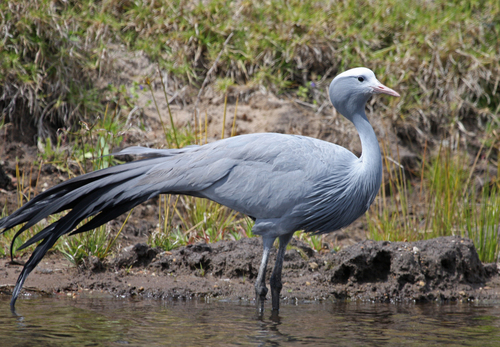
Uniformly pale blue-grey plumage with a white or very pale grey crown. Elongated dark grey wing feathers trail to the ground.
Key Features
- Distinctive bulbous head with a white crown
- Elongated inner secondary feathers that trail like a tail
- Uniform pale blue-grey body plumage
- Stately, upright posture standing nearly 4 feet tall
- Pinkish-grey bill and long black legs
When You’ll See Them
Geographic range
Where Does the Blue Crane Live?
The Blue Crane is almost entirely endemic to Southern Africa, with the vast majority of the population residing within the borders of South Africa. A small, isolated population is also found in the Etosha Pan region of northern Namibia. Within South Africa, their core range is concentrated in the central and eastern Highveld, the midlands of KwaZulu-Natal, and the sprawling wheat-growing regions of the Overberg in the Western Cape. They are iconic fixtures of the open Karoo landscape, where they thrive in the vast, treeless plains.
Basemap © OpenStreetMap contributors
Behavior
The Blue Crane is a bird of immense grace and social complexity, most famous for its elaborate 'dancing' displays. These performances involve bowing, jumping, running in circles, and tossing tufts of grass into the air, serving both as courtship rituals and social bonding exercises. Despite their delicate appearance, they are highly territorial during the breeding season and will aggressively defend their nest sites from intruders, including much larger animals.
Outside of the breeding season, Blue Cranes are gregarious, gathering in large flocks that can number in the hundreds. These flocks often frequent agricultural lands, where they move with a slow, measured gait. They are diurnal birds, spending their days foraging in open fields and their nights roosting in shallow water to protect themselves from land-based predators like caracals or jackals.
While they are generally wary of humans, they have adapted remarkably well to certain agricultural landscapes, particularly in the Western Cape of South Africa. However, they remain sensitive to direct disturbance at their nesting sites. They are known for their loud, rattling 'kwaaa-ork' calls, which can carry for several kilometers across the open plains.
EverydayEarth exclusive
Camera Tips
To capture the Blue Crane on a backyard or trail camera, placement is everything. Because these are tall birds with a wide field of view, avoid mounting your camera too low to the ground unless you are specifically aiming for 'feet shots.' Instead, mount the camera at waist height (about 1 meter) and angle it slightly upward or keep it level. This ensures you capture the full height of the bird and its distinctive bulbous head. Position the camera on the edge of open grassy areas or near shallow water bodies where they might roost or drink.
Cranes are easily spooked by new objects in their environment. If you are placing a camera in an open field, try to camouflage it against a fence post or a lone shrub. Avoid using bright white flash at night, as this can startle the birds and cause them to abandon a roosting site; instead, opt for 'No Glow' infrared LEDs. Since they are most active during the early morning and late afternoon, ensure your camera's trigger speed is high to catch them as they walk or perform their quick jumping 'dances.'
If you live on a farm or large estate, placing the camera near spilled grain or recently harvested wheat fields is a surefire way to get activity. However, do not use artificial lures or bait specifically to attract them, as they are a vulnerable species and should remain wild. Instead, focus on natural movement corridors. Set your camera to 'Burst Mode'—capturing 3-5 photos per trigger—to increase your chances of catching a frame where the bird is performing its iconic wing-spreading display.
Similar Species
Species that look similar or are commonly confused with Blue Crane.
Frequently Asked Questions
Record Blue Crane at your habitat
Connect a camera to start building your own species record — AI identifies every visitor automatically.