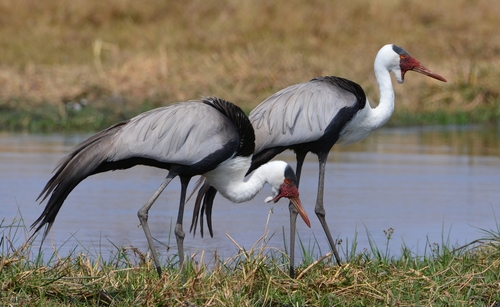
Wattled Crane
Grus carunculatus
The Wattled Crane is Africa's tallest and rarest crane, instantly recognizable by the unique fleshy 'wattles' hanging from its throat. A symbol of pristine wetland health, these elegant birds are a masterclass in avian grace and conservation priority.
Quick Identification
Size
Height: 150-175 cm (4.9-5.7 ft); Wingspan: 230-260 cm (7.5-8.5 ft); Weight: 6.4-9 kg (14-20 lbs)
Colors
Ash-grey back and wings, white neck and chest, black belly and tail. Bright red skin on the face with two distinctive white feathered wattles.
Key Features
- Two white feathered wattles hanging from the throat
- Bright red skin patch between the bill and eyes
- Tallest crane in Africa with a long, robust bill
- Contrasting white neck against a black belly
When You’ll See Them
Geographic range
Where Does the Wattled Crane Live?
Native to the African continent, the Wattled Crane maintains its primary strongholds in the vast floodplains of South-central Africa, particularly within the Okavango Delta and the Kafue Flats. Its distribution spans from the rugged highlands of Ethiopia in the north, through the river basins of Zambia, Botswana, and Mozambique, reaching down to the mist-belt grasslands of South Africa. While they were historically more widespread, their current range is increasingly fragmented, limited to areas where large-scale wetland ecosystems remain intact.
Basemap © OpenStreetMap contributors
Behavior
Wattled Cranes are highly specialized birds, deeply dependent on large, undisturbed wetland systems. Unlike more social crane species that may form massive flocks, Wattled Cranes are typically found in pairs or small family groups. They are famous for their spectacular courtship displays, which include synchronized leaping, bowing, and tossing pieces of vegetation into the air—a behavior that serves to strengthen pair bonds and signal territory.
These cranes are generally shy and wary of human encroachment. They spend the majority of their daylight hours foraging in shallow water, using their powerful bills to dig deep into the mud. While they are usually quiet, when they do call, they produce a loud, guttural croak that can carry for miles across the floodplains. They are slow breeders, usually raising only one chick at a time, which makes their populations particularly sensitive to environmental changes.
EverydayEarth exclusive
Camera Tips
To capture the majestic Wattled Crane, focus your camera placement on the transitions between open water and tall sedge beds. These birds are significantly taller than most backyard wildlife, so mount your camera at a height of approximately 3 to 4 feet (0.9 to 1.2 meters). This height ensures you capture the iconic wattles and facial details rather than just their long legs. Angle the lens slightly upward if you are positioning the camera near a known drinking or feeding spot along a muddy bank.
Because Wattled Cranes are extremely sensitive to human presence, a high-quality PIR (Passive Infrared) sensor is vital to trigger the camera from a distance. If your camera allows for it, use a 'Quiet' or 'Silent' shutter mode to avoid startling the birds, which may cause them to fly off and not return for days. Video mode is highly recommended for this species; a 20-30 second clip is often enough to capture their slow, deliberate walking pace or, if you're lucky, a portion of their leaping dance. Look for natural 'funnels' in the landscape, like narrow passages between reeds, to increase your chances of a close-up.
Lighting can be a challenge due to the high contrast between their bright white necks and dark bellies. Try to position your camera with the sun at its back to avoid silhouettes, especially during the 'golden hours' of early morning and late afternoon. During the breeding season, look for large mounds of vegetation in shallow water—these are their nests. However, ensure your camera is placed at least 50 meters away to prevent nest abandonment. Use a telephoto lens or a high-resolution sensor that allows for cropping if you are monitoring a nesting pair.
Similar Species
Species that look similar or are commonly confused with Wattled Crane.
Frequently Asked Questions
Record Wattled Crane at your habitat
Connect a camera to start building your own species record — AI identifies every visitor automatically.