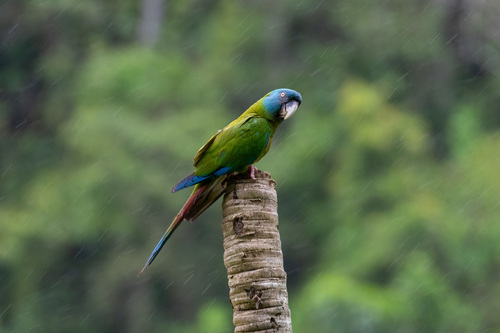
Blue-headed Macaw
Primolius couloni
A rare emerald of the Amazon, the Blue-headed Macaw is a stunning 'mini-macaw' known for its brilliant cobalt crown and secretive nature.
Quick Identification
Size
Length of approximately 41 cm (16 in); weight ranges from 250 to 350 grams (8.8 to 12.3 oz)
Colors
Primarily green plumage with a striking cobalt-blue head and crown. Flight feathers have blue edging, and the underside of the tail features a distinctive maroon-red base.
Key Features
- Brilliant cobalt-blue head and crown
- Dark gray to black bill with a pale horn-colored tip
- Maroon-red patch on the underside of the tail base
- Naked gray facial skin around the eyes
When You’ll See Them
Geographic range
Where Does the Blue-headed Macaw Live?
The Blue-headed Macaw is a South American treasure found in the western Amazon basin. Its core range is centered in eastern Peru, stretching from the foothills of the Andes into the humid lowlands. The species also extends its reach into northwestern Bolivia and the far western Brazilian state of Acre, maintaining a relatively restricted and specialized distribution compared to other macaws.
Basemap © OpenStreetMap contributors
Behavior
The Blue-headed Macaw is a relatively shy and elusive species compared to its larger, more boisterous relatives. Usually found in pairs or small family groups, they spend much of their time high in the forest canopy where their green bodies provide excellent camouflage against the foliage. While they are quieter than many other parrot species, they have a distinct, somewhat soft squawk that can give away their location when they take flight.
These macaws are highly social within their small groups but rarely congregate in the massive flocks seen in other species, except at mineral-rich clay licks. In these locations, they gather to ingest clay, which is thought to help neutralize toxins found in the seeds and unripe fruits they consume. Their interaction with humans is limited due to their remote habitat, though they are highly prized and unfortunately threatened by the illegal pet trade.
EverydayEarth exclusive
Camera Tips
Capturing a Blue-headed Macaw on camera requires patience and strategic placement, as these birds are naturally cautious. If you are in their native range, focus your efforts on 'colpas' or clay licks along riverbanks. These are the most reliable spots for ground-level or eye-level photography. Mount your camera on a sturdy tripod or a fixed tree mount overlooking the lick, but ensure it is well-camouflaged with local vegetation to avoid spooking the birds.
For backyard or garden setups in South American regions where they occur, fruiting trees like palms or local fig species are your best bet for attracting them. Place cameras at a height of at least 10-15 feet if possible, angling them toward a clear 'landing branch' near the fruit. Because they are active during the brightest parts of the day, set your camera to a fast shutter speed to freeze the motion of their wings and prevent blurring in the dappled forest light.
Using a motion-activated trail camera with a high-speed trigger is essential. Look for models with 'quiet' operation, as the mechanical click of some older cameras can startle them. Since these birds are often high in the canopy, a solar-powered external battery pack is a wise investment to keep your camera running for weeks without human intervention, which minimizes the scent and disturbance that might drive these shy birds away.
Similar Species
Species that look similar or are commonly confused with Blue-headed Macaw.
Frequently Asked Questions
Record Blue-headed Macaw at your habitat
Connect a camera to start building your own species record — AI identifies every visitor automatically.