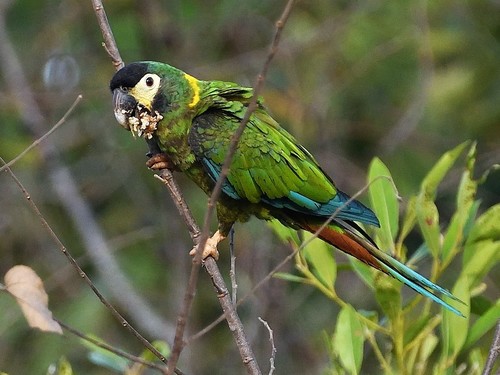
Yellow-collared Macaw
Primolius auricollis
The Yellow-collared Macaw is a brilliant 'mini-macaw' known for its striking golden nape and high intelligence. A resident of the South American heartland, it brings a flash of emerald green and social charm to backyards and forests alike.
Quick Identification
Size
37–40 cm (14.5–15.5 inches) long; 240–280g (8.5–10 oz) in weight
Colors
Primary body color is forest green; features a distinct yellow band across the back of the neck; forehead and crown are dark brownish-black; flight feathers are blue; tail is maroon at the base, turning green and blue toward the tip. Males and females look identical.
Key Features
- Bright yellow collar around the upper shoulders
- Large bare white skin patch on the face
- Dark brownish-black forehead contrasting with green body
- Small 'mini-macaw' proportions with a long, tapered tail
When You’ll See Them
Geographic range
Where Does the Yellow-collared Macaw Live?
The Yellow-collared Macaw is native to the central-southern regions of South America. Its primary range covers the vast Pantanal and Cerrado regions of central and southwestern Brazil, extending westward into the lowlands of eastern and northern Bolivia. It is also commonly found throughout the Chaco regions of northern Paraguay and northwestern Argentina. While they are essentially lowland birds, they have successfully moved into urban environments where ornamental planting provides a steady food supply.
Basemap © OpenStreetMap contributors
Behavior
Yellow-collared Macaws are highly social and intelligent parrots, typically observed in pairs or small family groups. They are loud and vocal, often heard before they are seen, using raucous squawks to communicate while navigating through the canopy or flying across open ground. Unlike some of their larger relatives, they are quite agile and can be found foraging in a variety of vertical layers, from the forest floor to the high treetops.
In human-adjacent areas, these macaws show a surprising level of adaptability. They are known to form strong, lifelong monogamous pair bonds, and pairs are frequently seen preening one another or flying in such close proximity that their wings nearly touch. They follow a predictable daily routine, leaving communal roosting sites at sunrise to forage and returning as the sun sets, making them excellent subjects for consistent camera monitoring.
EverydayEarth exclusive
Camera Tips
To capture high-quality footage of the Yellow-collared Macaw, camera placement is everything. These birds are wary of ground-level activity, so mounting your camera at a height of 10 to 15 feet (3-4.5 meters) is ideal. Aim the lens at a horizontal branch that provides a clear landing spot, particularly one near a fruiting palm or a consistent water source. If you are using a backyard setup, a sturdy platform feeder elevated high off the ground is the most likely spot to attract a visiting pair.
Because these macaws are extremely fast fliers, set your camera's shutter speed to at least 1/1000th of a second if possible, or use a high-frame-rate video setting (60fps or higher) to capture the brilliant blue of their wings in motion. Their peak activity occurs in the golden hours shortly after sunrise and just before sunset. To get the best color saturation—showing off that namesake yellow collar—position your camera with the sun at your back to illuminate the bird's nape as it perches.
If you live within their range, you can lure them to your camera using native fruits like papaya, mango, or even large sunflower seeds. However, the best 'bait' is often a large, shallow bird bath. Like most parrots, Yellow-collared Macaws need to drink and bathe daily, and they feel safest doing so in elevated water features. Use a high-sensitivity motion trigger, but try to mask out moving branches in the background to avoid thousands of empty 'false trigger' recordings caused by the wind.
Similar Species
Species that look similar or are commonly confused with Yellow-collared Macaw.
Frequently Asked Questions
Record Yellow-collared Macaw at your habitat
Connect a camera to start building your own species record — AI identifies every visitor automatically.