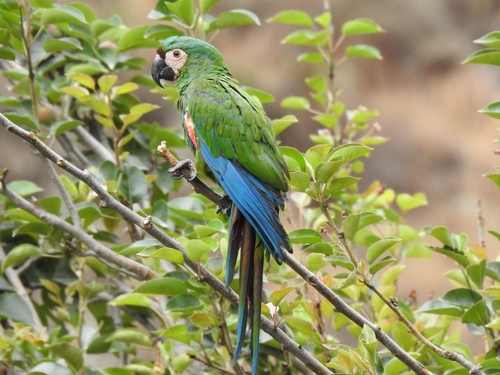
Chestnut-fronted Macaw
Ara severus
One of the largest 'mini-macaws,' the Chestnut-fronted Macaw combines the bold personality of its giant cousins with a sleek, agile green body. Look for their signature chestnut forehead and brilliant red underwings as they sweep across the tropical canopy.
Quick Identification
Size
Approximately 45-48 cm (18-19 in) in length; wingspan of 60-70 cm (24-28 in); weight ranges from 300-410g (10.5-14.5 oz).
Colors
Predominantly green plumage with a distinct chestnut-brown patch on the forehead; blue flight feathers and red patches on the underside of the wings; bare white facial patch with fine lines of black feathers.
Key Features
- Dark chestnut-brown patch on the forehead directly above the beak
- Bare white facial skin marked by rows of tiny black feathers
- Vibrant red 'shoulders' and under-wing coverts visible during flight
- Smaller 'mini-macaw' stature with a long, tapering tail
When You’ll See Them
Geographic range
Where Does the Chestnut-fronted Macaw Live?
Native to the lush tropical regions of Central and South America, the Chestnut-fronted Macaw boasts an expansive range that begins in eastern Panama and stretches across the northern half of the continent. It is a common sight throughout the Amazon Basin, spanning across Colombia, Venezuela, the Guianas, Brazil, and southward into eastern Peru and northern Bolivia. While traditionally forest-dwellers, they have successfully established small, localized introduced populations in urban areas of Southern Florida, where they frequent botanical gardens and suburban neighborhoods.
Basemap © OpenStreetMap contributors
Behavior
The Chestnut-fronted Macaw is a highly social and intelligent parrot, often found in pairs or small family groups that merge into larger flocks of up to 100 birds at roosting sites. They are famous for their loud, raucous calls which they use to communicate while flying or foraging. In the wild, they are cautious but can become quite bold when a reliable food source is discovered, often visiting the same trees daily at predictable times.
These macaws are incredibly agile flyers, capable of navigating through dense canopy with ease. While they spend much of their time high in the trees, they are known to descend to ground level or riverbanks to visit clay licks, which help neutralize toxins in their diet. In areas where they have become accustomed to humans, such as suburban edges near tropical forests, they show a remarkable ability to adapt to man-made environments and garden feeders.
EverydayEarth exclusive
Camera Tips
To capture the Chestnut-fronted Macaw on camera, height is your best friend. These birds are naturally arboreal and feel most comfortable at elevated positions. Mount your AI-powered camera at least 10 to 15 feet high, ideally overlooking a known fruiting tree or a high-platform bird feeder. Angle the camera slightly downward to catch the brilliant red under-wing coverts as they land, which is one of their most striking features.
Because these macaws are extremely fast and social, set your camera to 'Burst Mode' or high-frame-rate video. They rarely travel alone, so a single motion trigger often misses the second or third bird following the leader. Using a fast shutter speed setting is crucial to prevent motion blur during their rapid wing beats. Early morning light provides the best opportunity to capture the iridescent blues and greens of their feathers without the harsh midday glare of the tropical sun.
If you are trying to attract them to a backyard setup, use large, sturdy feeders stocked with whole walnuts, almonds, or sunflower seeds. These macaws are highly intelligent and will quickly learn the schedule of a reliable food source. Position your camera near a 'staging branch'—a bare limb near the feeder where the birds typically land to survey the area before moving in to eat. This often results in the cleanest, most unobstructed portraits.
Similar Species
Species that look similar or are commonly confused with Chestnut-fronted Macaw.
Military Macaw
Much larger with a bright red forehead patch instead of chestnut, and lacks the fine black feather lines on the face.
Blue-winged Macaw
Smaller with a yellowish-orange belly patch and a blue crown, lacking the chestnut forehead.
Red-bellied Macaw
Distinguished by a yellow facial patch and a visible red patch on the lower abdomen.
Frequently Asked Questions
Record Chestnut-fronted Macaw at your habitat
Connect a camera to start building your own species record — AI identifies every visitor automatically.