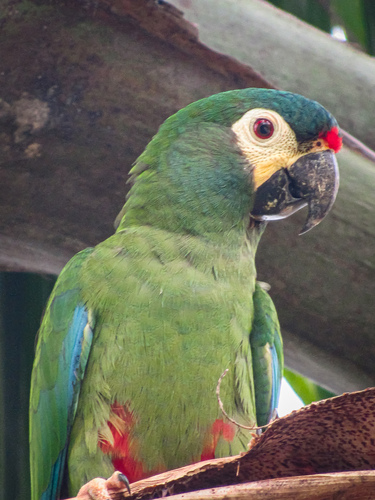
Blue-winged Macaw
Primolius maracana
A vibrant 'mini-macaw' of the South American woodlands, the Blue-winged Macaw is celebrated for its intelligence, social bonds, and striking splash of red and blue plumage.
Quick Identification
Size
Length: 36–43 cm (14–17 in); Wingspan: approximately 60 cm (24 in); Weight: 250–300 g (8.8–10.6 oz)
Colors
Mainly green plumage with distinct blue primary feathers; red patches on the forehead, lower back, and belly; facial skin is creamy white.
Key Features
- Small 'mini-macaw' profile
- Striking blue feathers on the wings and tail
- Red patch on the lower back and forehead
- Large black bill and bare white face
When You’ll See Them
Geographic range
Where Does the Blue-winged Macaw Live?
Native to the heart of South America, the Blue-winged Macaw is primarily found across central and eastern Brazil, extending southward into eastern Paraguay and historically into northeastern Argentina. While their range has contracted due to habitat loss, they remain a quintessential sight in the gallery forests and palm groves of the Cerrado and Atlantic Forest regions. As adaptable flyers, they are occasionally spotted in the outskirts of urban centers where large gardens and parks provide a secondary refuge.
Basemap © OpenStreetMap contributors
Behavior
The Blue-winged Macaw, also known as Illiger's Macaw, is a highly social and intelligent parrot that typically travels in pairs or small family groups. They are known for their loud, raucous calls which help maintain contact with their partner while flying across the canopy. Unlike larger macaws, they are quite agile in flight and exhibit a playful, inquisitive nature when foraging.
In areas where they feel safe, these macaws can become quite bold, often visiting the same fruiting trees daily. They spend a significant portion of their day preening one another to reinforce social bonds. While naturally wary of humans, they have shown a remarkable ability to adapt to fragmented landscapes and suburban edges, provided there are enough tall trees for nesting and escape cover.
EverydayEarth exclusive
Camera Tips
To capture the Blue-winged Macaw on camera, placement is everything. These birds spend the majority of their time in the upper canopy, so if you are using a trail camera in a backyard setting, aim for a high vantage point overlooking a known food source like a fruiting palm or a tall bird bath. They are particularly attracted to water in drier climates, so a high-elevation water feature is an excellent trigger point.
Set your AI-powered camera to a high shutter speed or 'Action' mode. Macaws are fast movers, and their wingbeats can easily blur in standard settings. Because they often travel in pairs, use a wider angle if possible to capture the social interaction between mates, which is one of the most charming aspects of their behavior.
Timing is critical; they are most active shortly after sunrise and again in the late afternoon before they head to communal roosts. If you are baiting an area, use native palm nuts or large sunflower seeds, but be patient—it may take several days for a wild pair to trust a new feeder setup enough to land in front of a camera lens.
Similar Species
Species that look similar or are commonly confused with Blue-winged Macaw.
Frequently Asked Questions
Record Blue-winged Macaw at your habitat
Connect a camera to start building your own species record — AI identifies every visitor automatically.