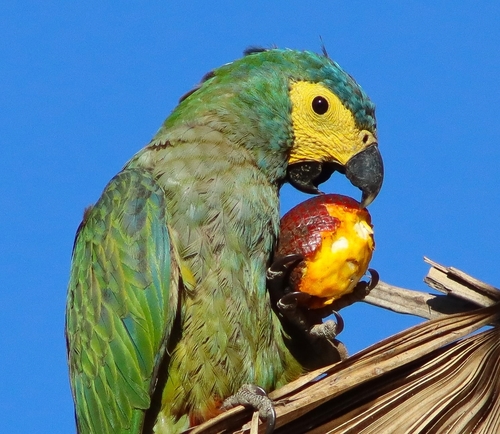
Red-bellied Macaw
Orthopsittaca manilatus
The Red-bellied Macaw is a vibrant, palm-loving socialite of the South American wetlands. With its signature maroon belly and mustard-yellow face, it is the crown jewel of the 'mini-macaw' world.
Quick Identification
Size
Length 46–51 cm (18–20 in); Weight 300–390 g (10.6–13.8 oz)
Colors
Primarily forest green with a large maroon-red patch on the lower belly; bare facial skin is a distinctive mustard yellow; forehead and crown have a bluish-teal tint.
Key Features
- Large maroon-red patch on the lower abdomen
- Bare yellow facial skin without feather lines
- Pointed wings and long, tapered tail
- Largest of the 'mini-macaws'
When You’ll See Them
Geographic range
Where Does the Red-bellied Macaw Live?
The Red-bellied Macaw is native to the vast tropical heartland of South America, centered primarily within the Amazon Basin. Its core range extends across Brazil, Peru, Colombia, Venezuela, and the Guianas, with southern reaches extending into northern Bolivia. While they are lowland specialists, you can also find established populations on the island of Trinidad, where they thrive in the Aripo Savannas and Nariva Swamp.
Basemap © OpenStreetMap contributors
Behavior
Red-bellied Macaws are highly social and gregarious birds, typically seen in large, noisy flocks that can number into the hundreds at communal roosts. They have an extremely specialized lifestyle centered around the Moriche palm (Mauritia flexuosa). These birds are most active during the early morning and late afternoon, filling the air with high-pitched, screaming calls as they commute between their nesting sites and feeding grounds.
While social with their own kind, they are notably shy and cautious around humans compared to larger macaw species. They prefer the safety of high palm canopies and are quick to take flight if they sense a disturbance. In flight, they are swift and direct, often flying in pairs or small family groups within the larger flock, creating a spectacular display of green and blue against the tropical sky.
EverydayEarth exclusive
Camera Tips
To capture the Red-bellied Macaw on camera, your best strategy is to locate their primary food source: the Moriche palm. If you have these palms on your property or nearby, aim your camera at the fruiting clusters. Because these birds spend most of their time high in the canopy, mounting your camera on a tall pole or a second-story balcony overlooking the palms will yield much better results than ground-level placement.
Lighting is crucial for bringing out the maroon belly patch and the subtle blue tones in their wings. Position your camera facing away from the morning sun (westward) to catch the golden hour light as they begin their morning forage. Using an AI-powered camera like EverydayEarth is particularly helpful here, as it can filter out the constant movement of wind-blown palm fronds, ensuring you only get recordings when the birds actually land.
Since these macaws are noisy, use a camera with a high-quality microphone. Their distinctive 'screaming' calls often precede their arrival by several minutes, giving you a chance to prepare or for the camera's pre-trigger to engage. If you are in a drier area, a high-mounted birdbath or a dripping water feature can also be a magnet, as they need to drink regularly after consuming oily palm fruits.
Similar Species
Species that look similar or are commonly confused with Red-bellied Macaw.
Frequently Asked Questions
Record Red-bellied Macaw at your habitat
Connect a camera to start building your own species record — AI identifies every visitor automatically.