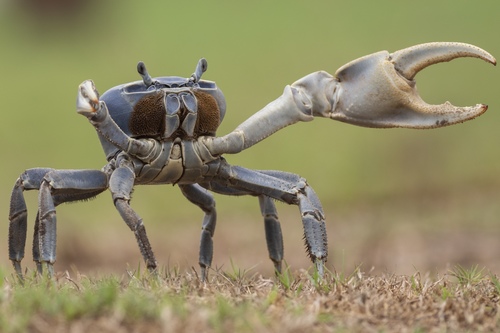
Blue Land Crab
Cardisoma guanhumi
Meet the blue-hued giant of the coastal garden. A master of the night and a champion burrower, the Blue Land Crab is one of the most striking invertebrates you'll find in your backyard.
Quick Identification
Size
Carapace width up to 15 cm (6 inches); total leg span can reach 30 cm (12 inches); weights average 500-600 grams (1.1-1.3 lbs).
Colors
Adults are typically a striking violet-blue to pale grey; juveniles and females are often more brown, orange, or dull grey in color.
Key Features
- Large, squared-off carapace with a smooth surface
- One pincer significantly larger than the other in males
- Eyes perched on long, movable stalks
- Sturdy, pointed legs designed for climbing and rapid scurrying
When You’ll See Them
Geographic range
Where Does the Blue Land Crab Live?
The Blue Land Crab is a native inhabitant of the tropical and subtropical Atlantic coastlines of the Americas. Its range stretches from the southern shores of Brazil and Colombia, up through the Caribbean islands and Central America, to the Gulf of Mexico. In the United States, they are most common throughout Florida, though their range has been expanding northward along the Atlantic coast to areas like Palm Coast and even as far as Bermuda.
Basemap © OpenStreetMap contributors
Behavior
Blue Land Crabs are fascinating terrestrial engineers that spend the majority of their lives on land, despite their biological need for water. They are famous for digging deep, complex burrows that can extend several feet underground to reach the moist water table. These burrows serve as their primary protection from predators and the drying heat of the sun. While generally solitary and territorial about their holes, they are known for massive, synchronized migrations during the summer rainy season, when thousands of adults head to the ocean to spawn.
These crabs are primarily nocturnal and quite shy, often retreating into their burrows at the slightest vibration from footsteps. However, if cornered, they will stand their ground by rearing up and waving their powerful claws. In residential areas, they are opportunistic neighbors that have adapted well to manicured lawns and gardens, though they remain wary of human interaction and domestic pets.
EverydayEarth exclusive
Camera Tips
To capture high-quality footage of a Blue Land Crab, your camera placement must be unconventional. Because these crabs are ground-dwellers, you should mount your camera just 6 to 10 inches off the ground. Aim the lens directly at a known burrow entrance or along a garden edge where you have seen activity. Since they are cold-blooded, traditional Passive Infrared (PIR) motion sensors can sometimes fail to trigger; for the best results, use a camera with high sensitivity settings or set it to a 'Time Lapse' mode with short intervals during the night.
Blue Land Crabs have a surprisingly strong sense of smell and can be lured into the camera's view with sweet, aromatic bait. Overripe bananas, mango skins, or even a slice of watermelon work wonders. Place the bait about 3 to 5 feet in front of the camera and secure it with a small stake—otherwise, the crab may simply pick up the entire prize and drag it back into its burrow before you get more than a single frame of footage.
Pay close attention to the weather and lunar cycles. These crabs are most active on humid nights following heavy rain. If you are looking for the 'holy grail' of crab footage—the spawning migration—monitor the full moon cycles during the summer months. During these times, the crabs move in large numbers toward the coast, providing ample opportunities for sightings. For evening shots, ensure your camera's infrared flash is unobstructed, as these crabs are almost entirely nocturnal in high-traffic suburban areas.
Similar Species
Species that look similar or are commonly confused with Blue Land Crab.
Frequently Asked Questions
Record Blue Land Crab at your habitat
Connect a camera to start building your own species record — AI identifies every visitor automatically.