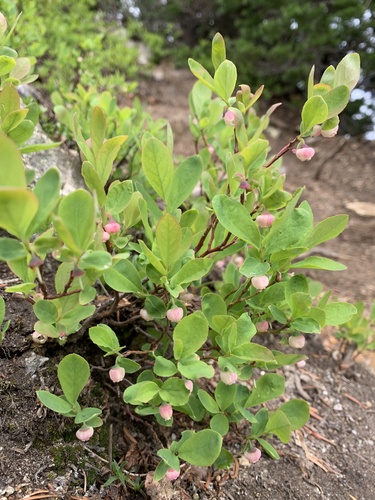
Blue-leaved huckleberry
Vaccinium deliciosum
The Blue-leaved huckleberry is the crown jewel of subalpine meadows, known for its stunning waxy foliage and the sweetest wild berries in the West. It is a vital resource for mountain wildlife, from tiny pollinators to massive grizzly bears.
Quick Identification
Size
A low-growing, mat-forming shrub reaching 10 to 40 cm (4 to 16 inches) in height.
Colors
Waxy blue-green leaves with a pale underside; pink to reddish bell-shaped flowers; dark blue berries with a thick waxy bloom.
Key Features
- Low-growing mat-like growth habit
- Waxy blue-green leaves with finely serrated edges
- Bell-shaped pinkish flowers
- Delicious blue-black berries with a heavy waxy coating
When You’ll See Them
Geographic range
Where Does the Blue-leaved huckleberry Live?
Native to the mountain ranges of western North America, the Blue-leaved huckleberry is a quintessential Pacific Northwest species. Its core range follows the Cascade and Olympic Mountains, stretching from British Columbia in Canada southward through Washington and Oregon to northern California. You will most often find it in protected subalpine zones within National Parks and wilderness areas where the soil remains moist from late-season snowmelt.
Basemap © OpenStreetMap contributors
Behavior
The Blue-leaved huckleberry is a hardy, long-lived perennial shrub that thrives in the challenging conditions of subalpine environments. Unlike its taller woodland cousins, it grows in low, dense mats that allow it to stay protected under heavy winter snowpacks. It spreads primarily through underground rhizomes, often forming extensive colonies that can cover entire hillsides in mountain meadows.
This species follows a strict seasonal rhythm tied to snowmelt. As soon as the sun clears the slopes in late spring, the plant rapidly produces its bell-shaped flowers to take advantage of the short growing season. It serves as a vital ecological hub; its flowers provide nectar for high-altitude pollinators like bumblebees, while its nutrient-dense berries are a critical energy source for wildlife preparing for winter hibernation or migration.
EverydayEarth exclusive
Camera Tips
When setting up a camera to monitor a Blue-leaved huckleberry patch, low-profile placement is the key to success. Because these shrubs rarely exceed 16 inches in height, you should mount your camera on a ground stake or a very low tripod, approximately 10 to 12 inches off the ground. Angle the lens slightly upward to capture the underside of the waxy leaves and the flowers, but also to ensure you catch the faces of visiting wildlife like Marmots or Sooty Grouse.
To capture the best color rendition of the unique blue-green foliage, avoid direct midday sun which can wash out the waxy 'bloom' on the leaves. Early morning light is ideal, as it often catches the dew on the berries and attracts early-rising pollinators. If your camera has a time-lapse feature, this is an excellent species to document over a 4-week period in late summer as the berries transition from green to their characteristic dusty blue-black.
During the peak fruiting season in August and September, Blue-leaved huckleberry patches become 'hotspots' for animal activity. You don't need artificial lures; the berries themselves are the primary attractant. Set your camera to a multi-shot burst mode. This is particularly effective for capturing fast-moving birds or the social interactions of Black Bears that may spend hours methodically grazing through a single patch. Be sure to use a high-capacity SD card, as a busy huckleberry patch can trigger hundreds of photos in a single afternoon.
Similar Species
Species that look similar or are commonly confused with Blue-leaved huckleberry.
Frequently Asked Questions
Record Blue-leaved huckleberry at your habitat
Connect a camera to start building your own species record — AI identifies every visitor automatically.