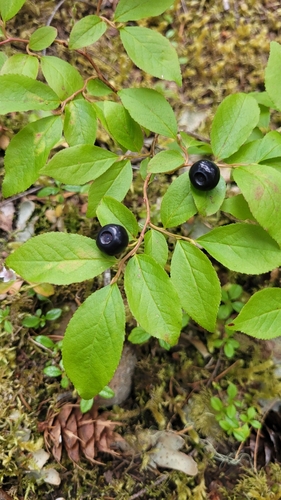
thinleaf huckleberry
Vaccinium membranaceum
The crown jewel of the Pacific Northwest's wild berries, the thinleaf huckleberry is more than just a hiker's snack—it is a vital lifeline for mountain wildlife. From its square-edged twigs to its brilliant red autumn foliage, this hardy shrub defines the high-country wilderness.
Quick Identification
Size
Height: 0.3-2 meters (1-6.5 feet); Spread: 1-1.5 meters (3-5 feet)
Colors
Bright green leaves turning vibrant red or burgundy in autumn; creamy pink to yellowish-green bell-shaped flowers; deep purple to near-black berries
Key Features
- Young twigs are slightly angled or 'square' in cross-section
- Thin, oval-shaped leaves with finely serrated edges and a pointed tip
- Single, bell-shaped flowers found in the leaf axils rather than clusters
- Berries are dark purple to black and typically lack the waxy white 'bloom' found on blueberries
When You’ll See Them
Geographic range
Where Does the thinleaf huckleberry Live?
Native to the rugged landscapes of western North America, the thinleaf huckleberry is a true mountain specialist. Its range extends from the high-latitude forests of British Columbia and Alberta in Canada down through the mountainous regions of the Pacific Northwest. In the United States, it is most common throughout Washington, Oregon, Idaho, and Montana, with its southern reach extending into the Sierra Nevada of California and the high peaks of Wyoming and Utah. It is rarely found at sea level, preferring the cool, thin air of the interior ranges and coastal mountains.
Basemap © OpenStreetMap contributors
Behavior
The thinleaf huckleberry is a slow-growing, resilient deciduous shrub that serves as a cornerstone of mountain ecosystems. Unlike many garden-variety berries, this species is famously difficult to cultivate at home because it relies on complex symbiotic relationships with soil fungi. In the wild, it often spreads via underground rhizomes, which allows the plant to survive and even thrive after forest fires, often becoming the dominant understory species in regenerating woodlands.
Its seasonal 'behavior' is closely tied to the mountain snowpack. It remains dormant under several feet of snow all winter, bursting into leaf as soon as the thaw begins. Because it blooms early in the spring, it is a vital early-season food source for pollinators like bumblebees. By late summer, the plant focuses all its energy into sugar production, resulting in the highly concentrated, tart-sweet berries that are a favorite for both human foragers and mountain wildlife.
EverydayEarth exclusive
Camera Tips
When setting up a camera to capture the thinleaf huckleberry, your primary goal is likely to document the parade of wildlife that visits the plant. During the 'berry season' in late summer, these shrubs become high-traffic hubs. Position your camera about 2 feet off the ground and roughly 5-8 feet away from a bush with a heavy fruit load. Aim the lens at a slight downward angle to capture everything from small rodents and birds to larger visitors like black bears. Because these plants often grow in the dappled light of a forest canopy, use a camera with a high-quality sensor to handle the high contrast between bright sunspots and deep shadows.
For those interested in the plant's stunning aesthetic, try a time-lapse setting. If you start your time-lapse in mid-July, you can capture the fascinating transition of the berries as they swell and darken from green to deep purple. If you continue into the fall, you'll see the leaves undergo a spectacular transformation from emerald green to a fiery, glowing red. For the best results, pick a shrub in a semi-open clearing where the lighting is more consistent throughout the day, and use a sturdy tripod to prevent shifting over weeks of recording.
Be aware that huckleberry bushes are magnet for 'camera curious' wildlife. Bears, in particular, are highly attracted to the scent of humans on equipment and the berries themselves. If you are placing a camera in a known huckleberry patch in bear country, a bear-proof security box is a mandatory investment. Avoid using any artificial lures or scents near the plant; the ripe berries are already the best natural attractant you could ask for, and you'll get more natural behavior from your subjects without interference.
Similar Species
Species that look similar or are commonly confused with thinleaf huckleberry.
Frequently Asked Questions
Record thinleaf huckleberry at your habitat
Connect a camera to start building your own species record — AI identifies every visitor automatically.