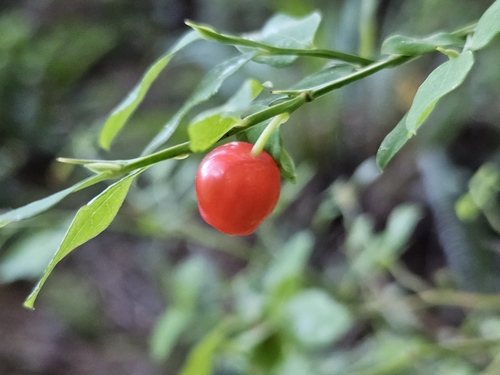
Red Huckleberry
Vaccinium parvifolium
A gem of the Pacific Northwest forest, the Red Huckleberry stands out with its bright green zigzag stems and jewel-like berries that attract a parade of forest wildlife.
Quick Identification
Size
A deciduous shrub typically reaching 1–4 meters (3–13 feet) in height, though it can occasionally grow up to 6 meters (20 feet).
Colors
Bright neon-green stems; translucent, vibrant red berries; small, oval light-green leaves; pinkish-white bell-shaped flowers.
Key Features
- Distinctive bright green stems with a sharp zigzag growth pattern
- Small, round, translucent red berries approximately 6–10mm in diameter
- Frequent growth directly out of decaying 'nurse logs' or stumps
- Thin, oval, deciduous leaves with smooth margins
- Solitary, bell-shaped flowers that hang from the leaf axils
When You’ll See Them
Geographic range
Where Does the Red Huckleberry Live?
The Red Huckleberry is a signature species of the Pacific Northwest and the western coast of North America. Its native range stretches from the rugged coastline of Southeast Alaska and through the lush temperate rainforests of British Columbia, Washington, and Oregon. It continues southward into California, where it is found in the cool, damp conditions of the coastal ranges as far as Central California. This shrub is a specialist of low-to-mid elevation maritime climates, rarely venturing far from the influence of the Pacific Ocean's moisture.
Basemap © OpenStreetMap contributors
Behavior
The Red Huckleberry is a fascinating deciduous shrub that plays a pivotal role in the ecology of the Pacific Northwest. Unlike many plants that require traditional soil, this species is often found growing atop decaying coniferous wood. These 'nurse logs' provide the acidic environment and steady moisture the Red Huckleberry needs to thrive. In the spring, the shrub produces waxy, bell-shaped flowers that are an essential early-season nectar source for rufous hummingbirds and various native bees.
As summer arrives, the plant transforms into a vital food hub. Its tart, vitamin-rich red berries are a high-energy resource for dozens of forest residents. While the plant itself is stationary, its 'behavior' in the ecosystem is one of high interaction; it serves as a nursery for insects, a buffet for mammals, and a structural shelter for ground-nesting birds. Even in the winter months when its leaves have fallen, its vibrant green stems provide critical browse for deer and elk when other food sources are scarce.
EverydayEarth exclusive
Camera Tips
To capture the best wildlife action around a Red Huckleberry, you need to treat the plant as a natural stage. Because these shrubs often grow out of decaying logs (nurse logs), they provide a perfect elevated platform for small mammals and birds. Position your camera at a height of about 2 to 3 feet, focused on a cluster of ripening berries or a section of the nurse log where the stems meet the wood. This setup is excellent for capturing chipmunks, squirrels, and varied thrushes as they come to forage.
Because Red Huckleberry thrives in the deep shade of the forest understory, lighting is your biggest challenge. AI-powered cameras with low-light optimization perform best here. If your camera settings allow for it, set a slightly higher trigger sensitivity during the morning hours (6 AM to 10 AM). This is when the light filters through the canopy and highlights the translucent red of the berries, making for stunning high-contrast footage. Avoid pointing the camera directly at patches of bright sky through the trees, as this can cause the dark forest floor and the plant to appear as a silhouette.
During the peak fruiting season in July and August, consider setting your camera to video mode rather than stills. This allows you to capture the rapid movements of hummingbirds visiting the flowers or the dexterous way a black bear uses its lips to strip berries from the zigzagging stems. If you are placing a camera in a backyard setting, planting a Red Huckleberry near a water feature can double your chances of capturing diverse bird species that will alternate between bathing and snacking on the tart fruit.
Similar Species
Species that look similar or are commonly confused with Red Huckleberry.
Frequently Asked Questions
Record Red Huckleberry at your habitat
Connect a camera to start building your own species record — AI identifies every visitor automatically.