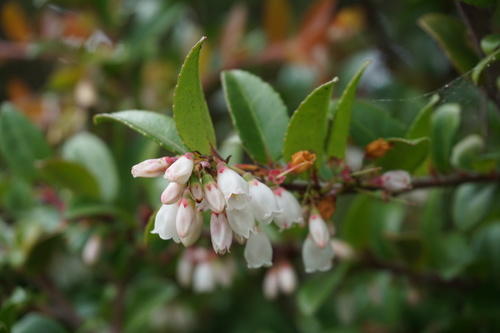
Evergreen Huckleberry
Vaccinium ovatum
A stunning coastal native, the Evergreen Huckleberry offers year-round beauty and a bountiful harvest for both humans and wildlife. Its glossy leaves and tart purple berries make it the crown jewel of any Pacific Northwest backyard.
Quick Identification
Size
Height of 0.6–2.4 meters (2–8 feet) in sun, reaching up to 4.5 meters (15 feet) in deep shade.
Colors
Glossy dark green upper leaves with pale undersides; new growth is bright copper or bronze; pinkish-white bell-shaped flowers; dark purple-black berries.
Key Features
- Leathery ovate leaves with finely serrated margins
- New foliage emerges in striking shades of bronze and red
- Small, pendulous white or pinkish urn-shaped flowers
- Clusters of edible, round berries maturing to deep purple or black.
When You’ll See Them
Geographic range
Where Does the Evergreen Huckleberry Live?
Native to the Pacific Northwest region of North America, the Evergreen Huckleberry thrives in a narrow coastal band stretching from southern British Columbia down through Washington and Oregon to central California. It is a signature species of the United States and Canada's temperate rainforests, particularly common within the salt-spray zone of the Pacific Ocean. While it remains centered in its native western range, it is increasingly found in cultivated landscapes across temperate climate zones as an ornamental favorite.
Basemap © OpenStreetMap contributors
Behavior
The Evergreen Huckleberry is a resilient, slow-growing shrub that plays a vital role in its ecosystem as both a shelter and a food source. In the garden, it is prized for its year-round foliage and its ability to thrive in varied light conditions, from deep shade to full sun. While it can remain a compact, dense bush in bright light, it tends to reach upward in the shadows of the forest understory, creating a lanky and graceful silhouette.
This plant is a powerhouse for wildlife interaction. In the spring, its nectar-rich flowers attract a flurry of native bees and hummingbirds. As the summer turns to autumn, the berries become a primary target for a wide range of mammals and birds. Humans also interact with the plant frequently, harvesting the tart, flavorful berries for jams and pies, or using the sturdy, attractive branches in floral arrangements.
EverydayEarth exclusive
Camera Tips
Capturing the Evergreen Huckleberry is less about the plant moving and more about the incredible diversity of wildlife it attracts. To get the best results, place your camera on a tripod or mount it to a nearby tree about 2 to 3 feet off the ground, angled slightly downward toward a cluster of ripening berries or a section of spring flowers. Because these shrubs are often located in the shade, ensure your camera has a high-quality sensor for low-light conditions to avoid grainy 'ghost' images of fast-moving birds.
Timing is everything with this species. During the spring (April to May), set your camera to 'Photo Burst' or high-speed video to catch hummingbirds and bumblebees visiting the bell-shaped blossoms. During the late summer harvest (August to October), switch to 'Video Mode' with a 15-20 second trigger. This is the best way to record the behavior of berry-eating visitors like Cedar Waxwings, Spotted Towhees, and even larger mammals like Raccoons or Black Bears if you are in a more rural area.
For the most professional look, position the camera so the morning sun hits the glossy leaves from the side; this creates a beautiful backlight that makes the red new growth or the dark berries pop against the deep green foliage. If you are using an AI-powered camera, you may need to adjust the sensitivity settings, as the movement of the branches in a stiff breeze can sometimes trigger false positives. Clearing away small, distracting twigs directly in front of the lens will help the AI focus on the actual wildlife visitors.
Similar Species
Species that look similar or are commonly confused with Evergreen Huckleberry.
Frequently Asked Questions
Record Evergreen Huckleberry at your habitat
Connect a camera to start building your own species record — AI identifies every visitor automatically.