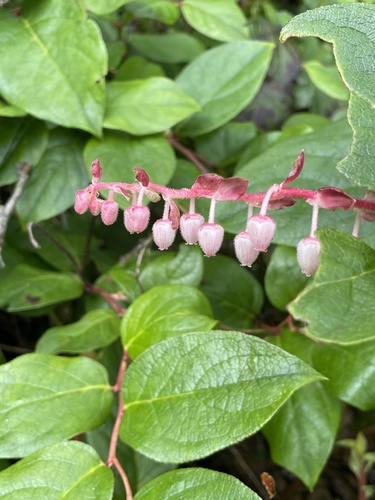
salal
Gaultheria shallon
The resilient heart of the Pacific Northwest forest, salal provides year-round greenery, edible berries, and essential shelter for backyard wildlife.
Quick Identification
Size
Typically 0.2 to 2 meters (8 inches to 6.5 feet) tall, but can reach 5 meters (16 feet) in shaded, coastal conditions.
Colors
Leathery dark green upper leaves, paler green undersides, reddish stems, white to pinkish flowers, and dark purple-black berries.
Key Features
- Egg-shaped leathery leaves with finely serrated edges
- Sticky, hairy reddish-brown stems
- Drooping clusters of white or pink bell-shaped flowers
- Dull, dark purple-black fleshy berries (edible)
When You’ll See Them
Geographic range
Where Does the salal Live?
Salal is a quintessential resident of the Pacific Northwest, hugging the misty coastline of North America. Its native range extends from the Alaska Panhandle down through British Columbia, Washington, and Oregon, reaching as far south as the redwood forests of California. While it thrives in the United States and Canada, it has been introduced to the United Kingdom and parts of Western Europe, where it has occasionally become naturalized in damp, acidic woodlands.
Basemap © OpenStreetMap contributors
Behavior
Salal is an incredibly resilient, colony-forming evergreen shrub that dominates the understory of Pacific coastal forests. It spreads primarily through an extensive network of underground rhizomes, allowing it to form nearly impenetrable thickets that provide vital cover for small mammals and ground-nesting birds. This growth habit makes it a primary competitor in post-logging environments, where it can quickly reclaim sunlit soil.
Ecologically, salal serves as a cornerstone species. In the spring, its urn-shaped flowers are a magnet for hummingbirds and bees. By late summer, the plant produces abundant dark fruit that was historically a staple food for Indigenous peoples of the Pacific Northwest and remains a critical food source for wildlife. The leaves are thick and waxy, designed to shed the heavy rainfall typical of its native range while resisting browsing from all but the hungriest deer.
EverydayEarth exclusive
Camera Tips
To capture the best images of salal with a trail or backyard camera, focus on the plant's seasonal transitions. During late spring (May and June), position your camera at a low angle, roughly 1 to 2 feet off the ground, to capture the delicate, nodding clusters of white-pink flowers. Because the flowers hang downward, an upward tilt on your camera lens will reveal the intricate 'urn' shape that attracts pollinators like the Rufous Hummingbird.
If your goal is to capture wildlife interacting with the plant, target the berry-ripening season in late summer. Salal berries are a favorite of Black Bears, Douglas Squirrels, and various songbirds. Place your camera near a large, established thicket where the fruit is most abundant. Use a wide-angle setting if possible, as thickets can be dense and close-up movement may trigger the camera too late if the field of view is too narrow.
For the best lighting, aim for the 'golden hour' or overcast days. Salal’s waxy, leathery leaves are highly reflective; direct midday sun can cause harsh highlights and 'blown-out' white spots in your photos. A misty or rainy day actually enhances the deep greens and reds of the plant, making for a more atmospheric and 'true-to-the-Pacific-Northwest' shot. If your camera has a macro mode or adjustable focus, use it to highlight the sticky, glandular hairs on the stems, which are a fascinating identifying feature.
Since salal is evergreen, it provides a consistent green backdrop for winter wildlife photography. In snowy conditions, the dark green leaves provide a beautiful contrast. Ensure your camera is secured to a sturdy post or tree, as the weight of wet snow on salal branches can cause them to sag and block your camera’s sensor or lens, leading to false triggers or obscured views.
Similar Species
Species that look similar or are commonly confused with salal.
Frequently Asked Questions
Record salal at your habitat
Connect a camera to start building your own species record — AI identifies every visitor automatically.