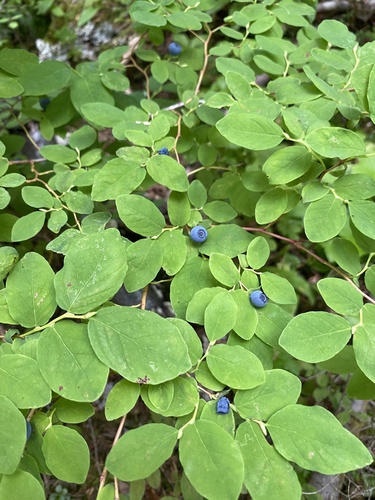
Oval-leaf Blueberry
Vaccinium ovalifolium
A cornerstone of the northern forest, the Oval-leaf Blueberry provides early-season nectar and a summer bounty of deep blue fruit for wildlife and foragers alike.
Quick Identification
Size
1 to 3 meters (3.3 to 10 feet) tall with a similar spread
Colors
Bright green to blue-green leaves; pink, creamy-white, or bronze bell-shaped flowers; dark blue to black berries
Key Features
- Thin, oval to elliptical leaves with smooth or finely serrated margins
- Pinkish, urn-shaped flowers that often bloom before leaves fully expand
- Dark blue to matte black berries, frequently lacking a waxy bloom
- Yellow-green to reddish twigs that are slightly angled or grooved
When You’ll See Them
Geographic range
Where Does the Oval-leaf Blueberry Live?
The Oval-leaf Blueberry is native to the temperate and boreal regions of both North America and Eastern Asia. In the Western Hemisphere, its core range extends from the Aleutian Islands and Alaska down through the Pacific Northwest into Oregon, stretching eastward across Canada to the Great Lakes and Newfoundland. Across the Pacific, it is commonly found in the mountainous regions of Japan, the Russian Far East, and the Kamchatka Peninsula.
Basemap © OpenStreetMap contributors
Behavior
The Oval-leaf Blueberry is a resilient deciduous shrub known for its early seasonal start. It is among the first understory plants to flower in the spring, offering a vital nectar source for early-emerging pollinators like bumblebees and rufous hummingbirds. The plant grows in a spreading, multi-stemmed fashion, often forming intricate thickets that provide excellent nesting cover for ground-dwelling birds and small mammals.
By mid-summer, the shrub transitions into its fruiting stage, producing a bounty of tart, nutritious berries. This species is a cornerstone of the forest food web; its fruit is a high-energy resource for everything from cedar waxwings to black bears. While it is slow-growing compared to some garden varieties, it is incredibly long-lived and can survive in the deep shade of old-growth canopies where other fruit-bearing plants struggle.
EverydayEarth exclusive
Camera Tips
To capture the diverse wildlife that visits the Oval-leaf Blueberry, position your trail camera about 2 to 3 feet off the ground, tilting it slightly downward to focus on the berry-laden branches. This height is perfect for documenting visitors like American Robins, Varied Thrushes, and small mammals like martens or chipmunks. If your camera is in an area frequented by bears, ensure it is protected by a heavy-duty security box, as bears are highly attracted to the scent of these berries and may investigate the device.
Timing is critical for getting the best footage. Set your camera to 'Burst Mode' or short video clips during the peak ripening window, which usually occurs from July to August depending on your latitude. This is when activity is highest, as animals compete for the harvest. Because these shrubs often grow in the dappled light of dense forests, use a camera with a high-quality CMOS sensor to handle the high-contrast lighting of sun-flecks or the low-light conditions of the deep woods.
For a unique botanical perspective, use a time-lapse setting to record the plant's phenology. Mounting the camera 6 to 8 feet away and taking one photo per day from late winter through autumn will beautifully capture the 'green-up,' the emergence of pink blossoms, and the eventual transition of the leaves to their brilliant yellow or red fall colors. Make sure to clear any small twigs immediately in front of the lens, as wind-blown movement can trigger thousands of false motion alerts on sensitive AI cameras.
Similar Species
Species that look similar or are commonly confused with Oval-leaf Blueberry.
Frequently Asked Questions
Record Oval-leaf Blueberry at your habitat
Connect a camera to start building your own species record — AI identifies every visitor automatically.