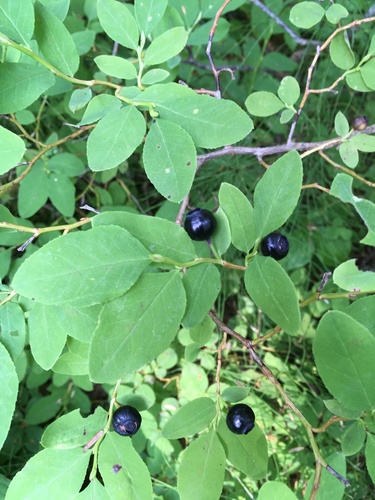
Alaska Blueberry
Vaccinium alaskaense
A crown jewel of the Pacific Northwest understory, the Alaska Blueberry is a vital lifeline for mountain wildlife. From its delicate spring blossoms to its deep summer fruits, it provides a seasonal stage for bears, birds, and pollinators alike.
Quick Identification
Size
Reaches heights of 1-2 meters (3-6 feet) with a canopy spread of up to 1.5 meters (5 feet).
Colors
Bright green to bluish-green foliage; pinkish-white flowers; dark blue to black berries with a waxy coating.
Key Features
- Oval-shaped leaves with smooth or very finely serrated margins
- Pinkish-white, urn-shaped flowers appearing with or before leaves
- Dark blue-black berries with a dull waxy bloom
- Twigs are yellow-green and slightly angled when young
When You’ll See Them
Geographic range
Where Does the Alaska Blueberry Live?
Native to the coastal regions of western North America, the Alaska Blueberry thrives in the 'fog belt' of the Pacific Northwest. Its range spans from the Aleutian Islands and the panhandle of Alaska, following the rugged coastline through British Columbia and into the Olympic Peninsula and Cascade Range of Washington and Oregon. It is most commonly found in old-growth forests where the soil is rich in decaying organic matter.
Basemap © OpenStreetMap contributors
Behavior
The Alaska Blueberry is a deciduous shrub that follows a strict seasonal cycle dictated by the cool, moist climates of the Pacific Northwest. In early spring, often before the snow has fully melted, the plant produces delicate, bell-shaped flowers that are a critical early nectar source for emerging bumblebees. As the season progresses, the foliage expands into a lush green, providing dense cover for ground-nesting birds and small mammals.
During the late summer months, the shrub enters its most active period of interaction with wildlife as its berries ripen. Unlike some species that drop fruit all at once, the Alaska Blueberry often has a staggered ripening process, which keeps foragers returning to the same bush for several weeks. This plant has a symbiotic relationship with local fauna; animals gain high-energy sugar and antioxidants, while the plant achieves seed dispersal as animals move through the forest.
EverydayEarth exclusive
Camera Tips
To capture the most wildlife action on your Alaska Blueberry, position your camera about 3 to 4 feet off the ground and 6 feet away from the center of the bush. This height is the ideal 'sweet spot' for capturing Black Bears and Sitka Black-tailed Deer that stand to browse on the berries and leaves. Because the shrub is dense, try to find a gap in the foliage where you can see through to the internal stems, as this is where birds like the Varied Thrush often hide while feeding.
Use a high-sensitivity trigger setting during the mid-summer ripening months. Wildlife activity spikes significantly when the berries turn from green to deep blue. If your camera has a time-lapse feature, set it to take a photo every 2-3 hours during the day. This creates a beautiful visual record of the berries ripening and allows you to pinpoint the exact days when the local wildlife 'discovers' the crop is ready for harvest.
For those interested in macro-wildlife, aim a secondary camera at a specific cluster of pink flowers in the spring. Pollinators like the Western Bumblebee are frequent visitors, but they move fast. A fast shutter speed or a high-frame-rate video setting is necessary to catch the details of pollination. Avoid placing the camera facing directly into the sun (south-facing), as the waxy coating on the leaves can create a 'white-out' glare that obscures the animals visiting the plant.
Similar Species
Species that look similar or are commonly confused with Alaska Blueberry.
Frequently Asked Questions
Record Alaska Blueberry at your habitat
Connect a camera to start building your own species record — AI identifies every visitor automatically.