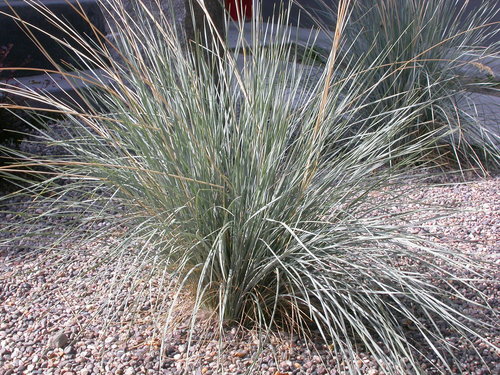
Blue Oat-grass
Helictotrichon sempervirens
With its striking steel-blue blades and elegant fountain-like form, Blue Oat-grass is the ultimate architectural plant for the modern wild garden. This hardy European native brings texture, movement, and a touch of alpine cool to any landscape.
Quick Identification
Size
Foliage reaches 60-90 cm (2-3 ft) tall and wide; flower spikes reach up to 120 cm (4 ft)
Colors
Steel-blue to silvery-gray foliage; flowers emerge blue-green and mature to a golden-tan
Key Features
- Dense, symmetrical mounding bunchgrass habit
- Stiff, needle-like blue-gray evergreen blades
- Tall, arching flower panicles resembling oat grains
- Non-invasive clumping growth
- Drought-tolerant, fine-textured foliage
When You’ll See Them
Geographic range
Where Does the Blue Oat-grass Live?
Native to the rugged grasslands and mountainous regions of central and southwest Europe, Blue Oat-grass is a hallmark of the French and Italian Alps. It naturally thrives on sun-baked, rocky slopes where drainage is fast and the air is cool. Beyond its native European home, it has become a beloved ornamental staple in temperate gardens throughout North America, the United Kingdom, and parts of Australia, where it is frequently used in xeriscaping and drought-tolerant designs.
Basemap © OpenStreetMap contributors
Behavior
Blue Oat-grass is a perennial ornamental bunchgrass prized for its architectural form and striking metallic hue. Unlike many grasses that spread via underground runners, this species remains in a disciplined, rounded clump, making it an ideal 'specimen' plant for modern landscapes and rock gardens. It is a cool-season grass, meaning it puts on its most vigorous growth during the spring and fall when temperatures are mild.
In the wild, this grass is a hardy survivor, often found clinging to rocky slopes and alpine meadows. In a backyard setting, it serves as a structural element that provides movement and sound as the wind whistles through its stiff blades. While it is mostly sedentary, it interacts with the local ecosystem by providing nesting material for birds and serving as a landing platform for various predatory insects like dragonflies.
EverydayEarth exclusive
Camera Tips
To capture the stunning architectural symmetry of Blue Oat-grass, mount your camera at a low angle, approximately 10-15 inches from the ground. This perspective emphasizes the 'fountain' effect of the blue blades against the sky. If your camera allows for manual focus, set it to the foreground blades to capture the intricate silver glint of the foliage, especially during the early morning when dew drops often cling to the needle-like tips.
Lighting is critical for this species; position your camera to the East or West to take advantage of 'backlighting' during the golden hour. When the sun sits low behind the grass, the translucent flower spikes and the edges of the blue blades will glow, creating a dramatic halo effect. This is also the best time to capture the motion of the grass in the breeze, which provides a sense of life to your backyard footage.
While the grass is the subject, it often acts as a stage for wildlife. Small songbirds frequently visit the seed heads in late summer, and ladybugs or lacewings are often found crawling through the dense center. Use a high-trigger speed or video mode to capture these quick interactions. In winter, keep the camera rolling; the stiff blades hold frost and snow beautifully, providing some of the most striking structural images of the dormant season.
Similar Species
Species that look similar or are commonly confused with Blue Oat-grass.
Frequently Asked Questions
Record Blue Oat-grass at your habitat
Connect a camera to start building your own species record — AI identifies every visitor automatically.