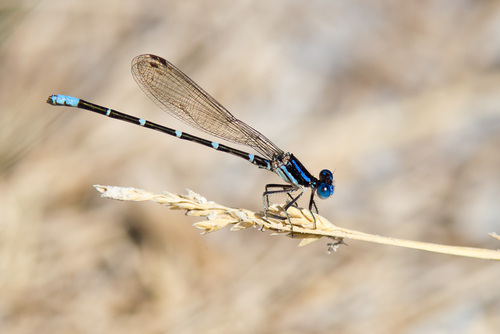
Blue-ringed Dancer
Argia sedula
With its electric blue markings and rhythmic, bouncing flight, the Blue-ringed Dancer is a captivating visitor to sunny shorelines and backyard ponds. A master of aerial agility, this small but striking damselfly is a favorite for backyard naturalists and macro photographers alike.
Quick Identification
Size
29–37 mm (1.1–1.5 inches) in length; wingspan approximately 40–50 mm (1.6–2.0 inches)
Colors
Males feature a vibrant sky-blue thorax with black stripes and a black abdomen tipped with brilliant blue rings on the final segments. Females are typically tan, brown, or grayish with subtle dark markings.
Key Features
- Bright blue tip on the male's abdomen (segments 8-10)
- Sky blue thorax with thin, dark longitudinal stripes
- Rests with wings folded together vertically over the back
- Characteristic 'dancing' flight pattern near water
- Prominent, widely spaced compound eyes
When You’ll See Them
Geographic range
Where Does the Blue-ringed Dancer Live?
The Blue-ringed Dancer is native to North America and Central America, where it thrives in sunny riparian environments. Its core range extends from the southern and central United States—particularly across the Sunbelt and Mid-Atlantic—southward through Mexico and into several northern Central American countries. It is widely distributed across these regions, appearing wherever permanent, slow-moving freshwater and ample sunlight are present.
Basemap © OpenStreetMap contributors
Behavior
The Blue-ringed Dancer earned its name from its distinctive, jerky flight pattern that appears more like a rhythmic dance than the straight-line flight of many other damselflies. Unlike many delicate damselfly species that hide deep within aquatic vegetation, Blue-ringed Dancers are bold and are frequently seen perching on flat, open surfaces. They favor sun-warmed rocks, mud banks, and even man-made structures like wooden docks or garden paths near the water's edge.
These insects are highly territorial and sun-loving. Males will stake out a 'perch' on a prominent stone or leaf, darting out to chase away rival males or to snatch small flying insects from the air. During the heat of the day, they are most active, often seen in 'tandem' pairs when mating, where the male uses the appendages at the end of his abdomen to clasp the female behind her head as they fly together toward egg-laying sites.
EverydayEarth exclusive
Camera Tips
To capture high-quality images of the Blue-ringed Dancer, focus your camera efforts on 'landing pads' rather than the water itself. These damselflies love to bask on flat, sun-exposed surfaces. Position your camera on a tripod at a very low angle—between 6 and 12 inches from the ground—aimed at a flat river rock or a piece of driftwood. Because they are small, a macro lens or a camera with a short minimum focus distance is essential to see the 'rings' that give them their name.
Since these insects are extremely fast, standard motion-trigger settings on trail cameras may only capture a 'ghost' or an empty frame. If your camera supports it, use a high-speed video mode (60fps or higher) or a 'Burst' photo mode. This increases the chances of catching the insect in the split second it remains still after landing. The best time for filming is during full sun, as the blue coloration on the male's thorax and abdomen is most reflective and vibrant under direct light.
You can encourage Blue-ringed Dancers to visit your camera's field of view by placing a dark, flat stone in a sunny spot near a backyard pond. Ensure there is no tall grass obscuring the camera's line of sight, as the movement of blades in the wind can cause false triggers. If you are using an AI-powered camera, ensure the firmware is updated to recognize 'Insects' or 'Odonates,' though manual focal locking on the basking rock is often the most reliable method for sharp results.
Similar Species
Species that look similar or are commonly confused with Blue-ringed Dancer.
Blue Dasher
A dragonfly with a much thicker, chalky-blue abdomen and wings that stay open when perched.
Azure Bluet
Smaller and more delicate with different black patterns on the abdomen; blue rings do not usually cover the entire tip of the tail.
Powdered Dancer
Males become covered in a pale, dusty-white pruinosity as they age, hiding the bright blue markings.
Frequently Asked Questions
Record Blue-ringed Dancer at your habitat
Connect a camera to start building your own species record — AI identifies every visitor automatically.