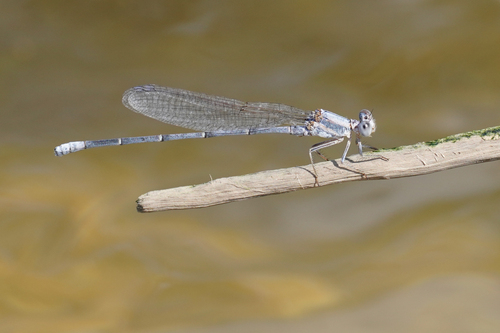
Powdered Dancer
Argia moesta
Looking like they've been dusted in fine white flour, the Powdered Dancer is a robust river-dweller. This master of the 'rock-perch' is a fascinating subject for any backyard naturalist with a nearby stream.
Quick Identification
Size
37-46 mm (1.5-1.8 inches) in length; wingspan approx. 45-55 mm (1.8-2.2 inches)
Colors
Mature males are covered in a chalky white or pale blue 'powder' (pruinosity); females are typically tan or brown with darker markings.
Key Features
- Chalky white or pale blue pruinosity on mature males
- Sturdy, robust body compared to other damselflies
- Wings held together over the back when resting
- Often found perching on rocks rather than vegetation
When You’ll See Them
Geographic range
Where Does the Powdered Dancer Live?
Native to the North American continent, the Powdered Dancer is one of the most widely distributed damselflies in the region. Its range extends from Nova Scotia and Ontario in Canada, down through the vast majority of the United States, and into central Mexico. While they are particularly prevalent in the river-heavy regions of the East and Midwest, they are also a common sight in the rocky riparian habitats of the American West and Southwest.
Basemap © OpenStreetMap contributors
Behavior
Powdered Dancers are agile aerial predators known for their distinctive flight and 'perching' habits. Unlike many damselflies that cling to thin blades of grass, Powdered Dancers prefer solid surfaces like sun-warmed rocks, concrete bridge supports, or bare ground near moving water. They are highly territorial and can often be seen chasing off other males from a prime sunning spot.
These insects are beneficial neighbors, as they spend their active hours hunting small flying pests. They use their 'dancing' flight—a series of quick, fluttering movements—to snatch gnats and mosquitoes right out of the air. When they aren't hunting, they are often seen in tandem during the mating process, with the male guarding the female as she deposits eggs into submerged wood or aquatic plants.
EverydayEarth exclusive
Camera Tips
Capturing high-quality images of the Powdered Dancer requires understanding their 'perch fidelity.' These damselflies often have a favorite rock or twig that they return to repeatedly after a hunting flight. Set your camera on a tripod and focus on a flat, light-colored rock located near the water’s edge that receives direct sunlight. A macro lens is highly recommended, as it allows you to capture the fine, flour-like texture of the pruinosity on the male's body, which is their most striking feature.
Since these insects are most active during the heat of the day, you will be working with bright, harsh light. To avoid 'blowing out' the white colors of the male, adjust your exposure compensation slightly downward (-0.3 or -0.7). If your camera has a 'pro capture' or 'pre-burst' mode, use it; damselflies are notoriously fast, and this feature helps you capture the moment they take off or land. Position your camera about 1 to 2 feet away from the target perch to ensure you don't spook them with sudden movements.
For backyard setups near a creek, you can actually 'create' a stage for them. Place a large, flat, dry rock in a sunny spot where the water ripples. Powdered Dancers are attracted to the thermal heat of the stone. If you are using a trail camera, ensure it has a fast trigger speed (0.2s or less) and a close-focusing capability. Because they are small, a standard trail camera may struggle to trigger; in these cases, time-lapse mode set to 5-second intervals during peak sun hours can be more effective for documenting their presence.
Similar Species
Species that look similar or are commonly confused with Powdered Dancer.
Frequently Asked Questions
Record Powdered Dancer at your habitat
Connect a camera to start building your own species record — AI identifies every visitor automatically.