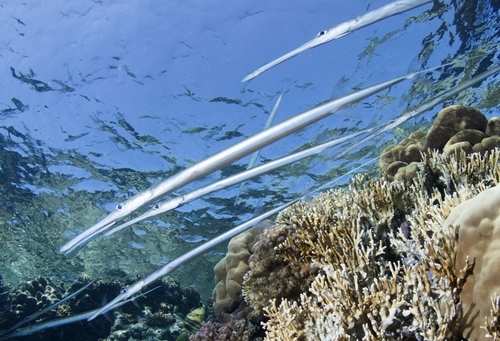
Blue-spotted Cornetfish
Fistularia commersonii
A shimmering needle of the sea, the Blue-spotted Cornetfish is a master of camouflage and high-speed suction feeding. Found across the world's tropical oceans, this slender predator is a favorite for reef watchers and underwater photographers alike.
Quick Identification
Size
60–100 cm (24–39 in) average, reaching up to 1.6 m (5.2 ft); weight is negligible due to extremely thin body.
Colors
Silver to greenish-grey with two iridescent blue stripes or rows of blue spots along the back; belly is typically white or pale.
Key Features
- Extremely long, slender, and depressed body
- Elongated, tube-like snout with a small terminal mouth
- Central tail filament extending from a forked caudal fin
- Iridescent blue spots or lines along the dorsal surface
When You’ll See Them
Geographic range
Where Does the Blue-spotted Cornetfish Live?
The Blue-spotted Cornetfish is a wide-ranging marine species native to the tropical and subtropical waters of the Indo-Pacific, stretching from the Red Sea and the coast of East Africa to the western shores of the Americas. This adaptable fish has also famously become a Lessepsian migrant, successfully colonizing the Mediterranean Sea after traveling through the Suez Canal. It is now commonly spotted from the warm reefs of Australia and Japan to the Mediterranean coasts of Israel, Turkey, and Italy, as well as the Hawaiian Islands and the Pacific coast of Mexico.
Basemap © OpenStreetMap contributors
Behavior
Despite their imposing length, they are remarkably docile and often show curiosity toward divers and underwater camera setups. They move with a subtle undulating motion of their fins, appearing almost weightless as they patrol reef edges and lagoons. When threatened or highly active, they can change their body color intensity to blend into the shadows of the reef or the bright glare of the surface.
EverydayEarth exclusive
Camera Tips
Lighting is your best friend when trying to highlight their signature blue spots. In shallow water, natural sunlight between 10 AM and 2 PM provides the best illumination. If your camera is deeper, consider using a diffused external video light; however, be aware that harsh lights may cause silver-bodied fish like the cornetfish to 'blow out' or overexpose in the frame. Using a wide-angle lens is highly recommended because their body length often exceeds the field of view of standard lenses at close range.
While they aren't attracted to traditional 'bait' in the way a shark might be, they are often drawn to areas with high concentrations of glassfish or small damselfish. Setting your camera near a 'cleaning station'—where smaller fish remove parasites from larger ones—is a fantastic strategy. Cornetfish often hover nearby, waiting for an easy meal or waiting their turn for a cleaning. Set your AI camera to trigger on movement, but ensure the sensitivity is high enough to detect their thin, needle-like silhouette, which can sometimes be missed by basic motion sensors.
Similar Species
Species that look similar or are commonly confused with Blue-spotted Cornetfish.
Frequently Asked Questions
Record Blue-spotted Cornetfish at your habitat
Connect a camera to start building your own species record — AI identifies every visitor automatically.