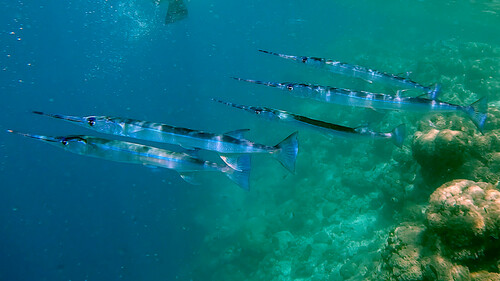
Reef Needlefish
Strongylura incisa
A sleek, silver arrow of the shallows, the Reef Needlefish is a master of surface-level hunting. With its needle-thin snout and iridescent scales, it is one of the most distinctive predators patrolling the Indo-Pacific reefs.
Quick Identification
Size
Typically ranges from 60 to 90 cm (24 to 35 inches) in length; weight varies but generally falls between 0.5 to 1.8 kg (1.1 to 4 lbs).
Colors
Brilliant silvery-blue or greenish dorsally, fading to a bright white or silver belly; often possesses a faint dark stripe along the side.
Key Features
- Extremely elongated jaws forming a needle-like beak
- Sharp, needle-like teeth visible when mouth is slightly open
- Dorsal and anal fins positioned very far back on the body
- Cylindrical, slender body shape
When You’ll See Them
Geographic range
Where Does the Reef Needlefish Live?
The Reef Needlefish is native to the vast tropical waters of the Indo-Pacific region. Its core range extends from the eastern coast of Africa through the Indian Ocean to the islands of Southeast Asia, northern Australia, and out into the central Pacific islands. It is frequently encountered in the coastal waters of Indonesia, the Philippines, and the Great Barrier Reef in Australia.
Basemap © OpenStreetMap contributors
Behavior
The Reef Needlefish is a specialized surface-dweller, often found gliding just inches below the water's surface in lagoons and reef flats. They are solitary hunters or travel in small, loose schools, using their slender profiles to remain nearly invisible to prey from below. Their swimming style is undulating and serpentine, but they are capable of incredible bursts of speed when startled or pursuing a meal.
One of their most striking behaviors is their tendency to leap out of the water. When threatened by predators or attracted by artificial lights at night, they can skip across the surface at high speeds. While generally wary of humans, they are often seen by snorkelers and pier-watchers, occasionally following swimmers out of curiosity or to catch small fish stirred up by movement.
EverydayEarth exclusive
Camera Tips
Capturing the Reef Needlefish requires a specialized approach, as these fish spend almost all their time at the very top of the water column. If you are using a dock-mounted camera looking down, a circular polarizing filter is absolutely essential. This filter will cut through the surface glare and reflections, allowing your AI camera to actually see the fish's silver body against the reef or sandy bottom. Position the camera at a 45-degree angle to the water surface for the best depth of field.
For those using underwater trail cameras or submerged housings, mount the camera high—no more than 12 to 24 inches below the surface. Reef Needlefish are highly attracted to areas where small baitfish congregate, such as near pier pilings or the edges of seagrass beds. They are also notoriously curious about shiny objects; some enthusiasts find that hanging a small, non-functional silver fishing spoon (without hooks) in the camera's field of view can lure them into the perfect frame.
Because these fish move with sudden, lightning-fast strikes, your camera settings should prioritize a high shutter speed (1/500s or faster) if manual controls are available. Use a wide-angle lens to capture their full, elongated bodies, as they can easily swim out of frame if the crop is too tight. At night, avoid using high-intensity white lights directly facing the water, as this can trigger their jumping reflex, which might lead them to leap over the camera or even land on your dock.
Lastly, timing is everything. Reef Needlefish are most active when the tide is coming in, as this pushes smaller prey into the shallow flats and lagoons. Check your local tide charts and ensure your camera is active during the two hours before and after high tide for the best chance of a sighting.
Similar Species
Species that look similar or are commonly confused with Reef Needlefish.
Houndfish
Much larger and heavier-bodied with a distinct lateral keel on the tail base.
Flat Needlefish
Identified by its strongly compressed, ribbon-like body and black pigment on the tongue.
Garfish
Usually refers to Hemiramphidae; they have a significantly shorter upper jaw compared to the lower jaw.
Frequently Asked Questions
Record Reef Needlefish at your habitat
Connect a camera to start building your own species record — AI identifies every visitor automatically.