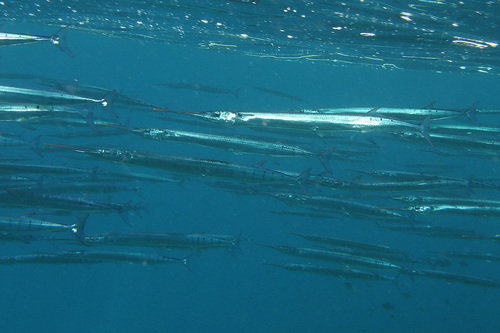
Flat Needlefish
Ablennes hians
The Flat Needlefish is a shimmering, ribbon-like predator that haunts the ocean's surface. Recognizable by its dark vertical bars and needle-thin beak, it is a master of high-speed coastal ambushes.
Quick Identification
Size
Typically 60-90 cm (24-35 inches), but can reach up to 140 cm (55 inches); weights usually range from 1-4 lbs.
Colors
Bluish-green on the back with shimmering silvery sides and 12-14 dark vertical bars; the bones and flesh are notably green.
Key Features
- Extremely compressed, ribbon-like body profile
- Dark vertical bars along the flanks
- Elongated beak-like jaws filled with needle-sharp teeth
- Lower lobe of the tail fin is longer than the upper
When You’ll See Them
Behavior
Flat Needlefish, also known as Barred Longtoms, are elite surface-dwelling predators known for their incredible speed and agility. Unlike other needlefish, their bodies are significantly flattened from side to side, allowing them to slice through the water with minimal resistance. They are often found cruising just inches below the surface, where they use their camouflage to blend in with the shimmering light of the waves.
These fish are solitary hunters but may congregate near structures like docks or bridges where baitfish gather. They are famous for their explosive leaping ability; when startled or chasing prey, they can skip across the water's surface at high speeds. While they are generally wary of humans, they are famously attracted to artificial light sources at night, which can occasionally cause them to leap toward boats or docks.
EverydayEarth exclusive
Camera Tips
To capture high-quality footage of Flat Needlefish from a backyard dock or seawall, position your camera 3 to 5 feet above the water line, angled downward at roughly 45 degrees. Because these fish live at the very top of the water column, surface glare is your biggest enemy. Use a circular polarizing filter over the lens to cut through reflections and reveal the fish's distinctive vertical bars and green-hued back. If your camera is AI-triggered, ensure the detection zone is set to the water's surface, though you may need to increase sensitivity to account for the ripples.
Nighttime offers the best opportunity for close-up shots. Flat Needlefish are intensely drawn to light. Submerge a green or white waterproof LED light 1-2 feet below the water's surface directly in the camera's field of view. This will attract small baitfish, which creates a natural 'stage' for the Needlefish to enter. Set your camera to a high frame rate—at least 60 frames per second—because their strikes are lightning-fast and will appear as a blur on standard settings.
For the best clarity, aim for 'slack tide' or the hour surrounding high tide when the water is often clearest and the fish move closer to shore structures. If you are using a trail camera with an infrared flash, be aware that the silvery scales of the Needlefish can cause overexposure. Adjust your exposure settings down by one or two notches to preserve the detail of their bars. In summer months, keep the camera running during early morning hours when the water is calmest for the most stable and crisp images.
Similar Species
Species that look similar or are commonly confused with Flat Needlefish.
Houndfish
Much larger and more robust with a cylindrical, tube-shaped body rather than a flattened one.
Atlantic Needlefish
Lacks the dark vertical bars and has a more rounded body cross-section.
Keeltail Needlefish
Identified by a prominent dark lateral keel on the tail base and a lack of vertical bars.
Frequently Asked Questions
Record Flat Needlefish at your habitat
Connect a camera to start building your own species record — AI identifies every visitor automatically.