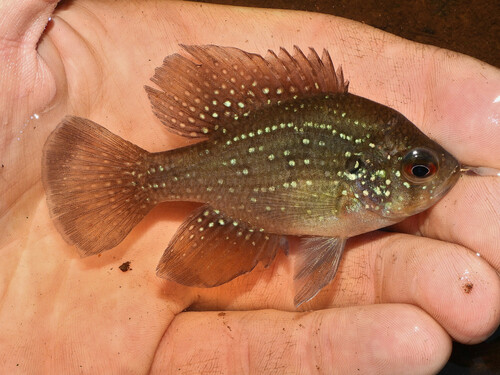
Blue-spotted Sunfish
Enneacanthus gloriosus
A hidden jewel of the eastern wetlands, the Blue-spotted Sunfish is a master of camouflage that shimmers with iridescent beauty when caught in the light.
Quick Identification
Size
Small and compact, typically measuring 6 to 9.5 cm (2.5 to 3.75 inches) in length and weighing less than 30 grams (1 ounce).
Colors
Body is olive to dark brown, adorned with numerous iridescent blue-green spots that extend onto the fins. Males display more intense coloration, especially during the breeding season.
Key Features
- Iridescent blue or green spots scattered across the body and fins
- Distinctly rounded tail fin (caudal fin)
- Small, laterally compressed body shape
- Dark vertical bars often faintly visible on the sides
When You’ll See Them
Geographic range
Where Does the Blue-spotted Sunfish Live?
Where Does the Blue-spotted Sunfish Live? This shimmering species is native to the Atlantic and Gulf Slope drainages of the United States. Its core territory stretches from the coastal plains of southern New York and New Jersey, extending southward through Florida and westward along the Gulf Coast to the Pearl River system in Mississippi. Beyond its native range, human activity has led to the establishment of introduced populations in regions such as the upper Susquehanna River and Lake Ontario.
Basemap © OpenStreetMap contributors
Behavior
The Blue-spotted Sunfish is a notably shy and secretive species, far less aggressive than its larger sunfish relatives. It spends the majority of its life tucked away within dense mats of aquatic vegetation, submerged root systems, or fallen woody debris. This preference for heavy cover makes them difficult to spot, as they rely on their dark, mottled coloration to blend into the shadows of their underwater environment.
Primarily diurnal, they are most active during the daylight hours when they forage for small invertebrates among plant stems. While they are generally solitary, they are tolerant of their own kind and can be found in loose groups where habitat is ideal. During the spring spawning season, males become more territorial, clearing small, shallow depressions in the substrate to attract females, though even then they remain relatively elusive compared to other members of the Centrarchidae family.
EverydayEarth exclusive
Camera Tips
To capture high-quality footage of the Blue-spotted Sunfish, placement of your underwater camera is everything. Because this species is small and stays close to cover, you should position your camera along the 'edge' of dense vegetation, such as lily pad stems, bladderwort, or submerged grasses. Use a weighted mount or a small tripod to ensure the camera sits just above the substrate, angled slightly upward to catch the light filtering through the water column.
Lighting is the biggest challenge in the stained blackwater environments where these fish thrive. Aim for recordings between 10 AM and 2 PM when the sun is at its zenith; this maximizes the light penetration necessary to make their iridescent blue spots 'pop' against their dark bodies. If your camera setup supports it, a gentle, diffused fill light can help reveal the intricate patterns that are often lost in the shadows of murky water.
Since Blue-spotted Sunfish are sensitive to movement and vibration, avoid frequently checking the camera. Leave it in a promising spot for several days to allow the fish to become accustomed to its presence. Look for 'corridors' or small clearings within the weeds where fish might pass through. You can often encourage activity by gently disturbing the bottom near the camera site once before leaving, which releases insect larvae and attracts foraging sunfish to the area.
Similar Species
Species that look similar or are commonly confused with Blue-spotted Sunfish.
Frequently Asked Questions
Record Blue-spotted Sunfish at your habitat
Connect a camera to start building your own species record — AI identifies every visitor automatically.