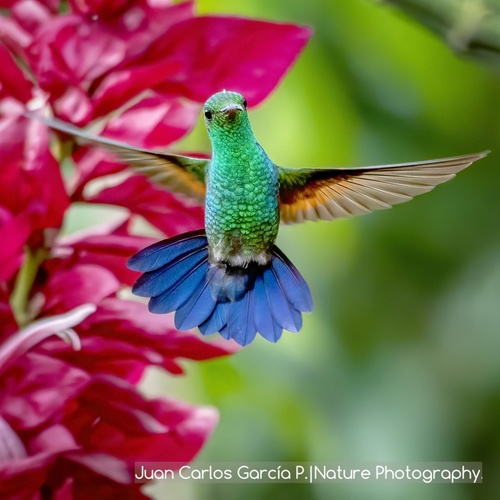
Blue-tailed Hummingbird
Saucerottia cyanura
A shimmering jewel of Central American highlands, the Blue-tailed Hummingbird dazzles with its emerald plumage and signature sapphire tail. This resilient and feisty 'emerald' is a common delight for backyard observers from Mexico to Costa Rica.
Quick Identification
Size
9–10 cm (3.5–4 in) in length; weight approximately 3.5–4.5g (0.12–0.16 oz)
Colors
Brilliant emerald green body; distinct rufous (cinnamon) patches on the wings; deep metallic blue or purplish-black tail
Key Features
- Deep metallic blue to purplish-black tail
- Bright rufous patches on the secondary wing feathers
- Glittering emerald green throat and crown
- Slightly decurved bill with a reddish-pink base on the lower mandible
When You’ll See Them
Geographic range
Where Does the Blue-tailed Hummingbird Live?
The Blue-tailed Hummingbird is a quintessential Central American species, thriving in a narrow but lush corridor of the subtropics. Its native range begins in the highlands of southern Mexico (Chiapas) and extends southward through the Pacific slopes of Guatemala, El Salvador, Honduras, and Nicaragua, eventually reaching its southern limit in northwestern Costa Rica. It is a permanent resident throughout this range, favoring mid-elevation habitats where the climate remains consistently humid and flowers bloom year-round.
Basemap © OpenStreetMap contributors
Behavior
The Blue-tailed Hummingbird is a high-energy, territorial species often found defending choice nectar sources with surprising ferocity. Like many members of the 'emerald' tribe, it is a frequent visitor to backyard feeders and flowering gardens, where it uses its agile flight to hover perfectly still while feeding. Despite its small size, it will aggressively chase away larger hummingbirds to protect its preferred foraging patches.
In social contexts, these birds are largely solitary except during the breeding season. They exhibit a 'trap-lining' feeding strategy, visiting a specific circuit of flowers throughout the day, but they are also quick to adapt to stationary food sources like sugar-water feeders. They are relatively comfortable around human habitation, often nesting in shrubs or low trees near houses where floral resources are abundant.
EverydayEarth exclusive
Camera Tips
To capture the stunning iridescence of the Blue-tailed Hummingbird, position your camera at a 45-degree angle to the morning sun. This 'side-lighting' helps highlight the metallic blue of the tail and the rufous wing patches that are often lost in deep shade. Mount your camera approximately 4 to 5 feet off the ground, level with a hummingbird feeder or a cluster of tubular flowers like Salvia or Hamelia patens.
Because these birds move with incredible speed, use a camera with a high trigger sensitivity or a specialized 'Bird' AI mode. If your camera allows for manual shutter speed settings, aim for 1/2000th of a second or faster to freeze the wing motion. For backyard setups, place a perching twig about 12 inches away from the food source; hummingbirds often pause there to survey the area before feeding, providing the perfect moment for a high-detail still shot.
If you are using a feeder to lure them, ensure it is cleaned every 2-3 days to keep the birds coming back. Avoid red dyes in the nectar, as the natural green and blue of the bird pop better against a clean, clear glass feeder. During the dry season (December to April), these birds are much more reliant on backyard water and nectar sources, making this the peak time for high-volume camera captures.
Similar Species
Species that look similar or are commonly confused with Blue-tailed Hummingbird.
Frequently Asked Questions
Record Blue-tailed Hummingbird at your habitat
Connect a camera to start building your own species record — AI identifies every visitor automatically.