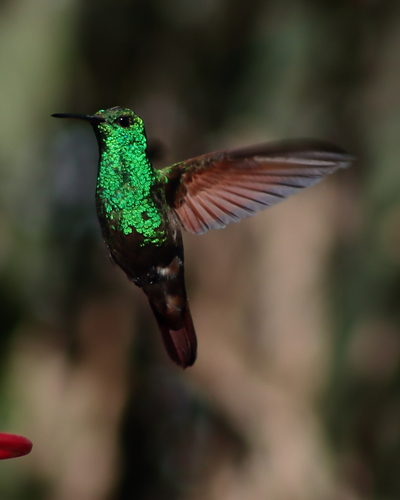
Berylline Hummingbird
Saucerottia beryllina
A dazzling jewel of the mountain woodlands, the Berylline Hummingbird captivates with its shimmering emerald plumage and distinctive cinnamon wings. This spirited visitor brings a splash of tropical brilliance to backyards from the Mexican highlands to the canyons of the American Southwest.
Quick Identification
Size
Length 8–11 cm (3.1–4.3 in); Wingspan approx 12 cm (4.7 in); Weight 4–5 g (0.14–0.18 oz)
Colors
Brilliant iridescent emerald-green body; distinct rufous-cinnamon patches on the wings and tail; lower mandible is reddish-pink at the base with a black tip.
Key Features
- Iridescent beryl-green throat and belly
- Cinnamon-colored wing coverts and tail
- Medium-length bill with red base on lower mandible
- Squared-off tail with violet or purplish highlights
When You’ll See Them
Geographic range
Where Does the Berylline Hummingbird Live?
This vibrant emerald traveler is native to North and Central America, with its heartland spanning throughout the highlands of Mexico down into El Salvador, Guatemala, and Honduras. While it is a year-round resident in most of its tropical range, it is a celebrated seasonal visitor to the 'Sky Islands' of the southwestern United States, particularly in southern Arizona and occasionally New Mexico. Because it favors elevations between 900 and 3,000 meters, it is most often found in cool, wooded canyons rather than the open desert floor.
Basemap © OpenStreetMap contributors
Behavior
Berylline Hummingbirds are spirited and highly territorial birds, often dominating flower patches or backyard feeders. They are known for their "trap-lining" behavior, following a regular route between favorite nectar sources, though they will also perch high on exposed branches to survey and defend their territory with sharp, buzzy calls. They are notoriously bold and will chase away much larger birds to protect a food source.
While they are primarily nectar-feeders, they are also agile insect hunters, often seen "hawking" (catching insects in mid-air) or gleaning spiders from webs. In the northern parts of their range, such as the canyons of southern Arizona, they are rare but charismatic visitors that show little fear of humans when a reliable food source like a sugar-water feeder is present.
EverydayEarth exclusive
Camera Tips
To capture the stunning iridescence of the Berylline Hummingbird, position your camera about 3 to 5 feet away from a hummingbird feeder or a cluster of red tubular flowers like Salvia or Penstemon. Since these birds move with incredible speed, use a camera with a high shutter speed or a specific bird-detection AI mode that triggers instantly upon motion. Angle the camera so the sun is behind you or to the side; direct backlighting often washes out the metallic green feathers, but side-lighting will make that "beryl" glow pop against the darker wing feathers.
Because Berylline Hummingbirds are highly territorial, they often have a favorite "sentinel perch"—a bare twig or wire near a food source where they sit to guard it. If you can identify this spot, mount your camera at eye level with the perch (usually 5–8 feet off the ground) for high-quality portraits. In the southwestern US, these birds are most active during the summer monsoon season (July and August), so ensure your camera is weather-sealed or protected from sudden afternoon downpours.
For the best video results, set your camera to at least 60fps (frames per second). This allows you to slow down the footage in post-production to see the incredible mechanics of their hovering wings. If your camera allows for zone-focusing, set the focus point specifically on the feeder ports or the "sentinel" twig to ensure the AI doesn't accidentally focus on moving foliage in the background during a windy day.
Similar Species
Species that look similar or are commonly confused with Berylline Hummingbird.
Broad-billed Hummingbird
Lacks the cinnamon wing patches of the Berylline and features a vibrant blue throat in males.
Buff-bellied Hummingbird
Has a pale buff-colored belly and a more deeply forked tail compared to the Berylline's green underparts.
Rufous Hummingbird
Much smaller with an almost entirely orange-brown body, lacking the Berylline's extensive emerald-green plumage.
Frequently Asked Questions
Record Berylline Hummingbird at your habitat
Connect a camera to start building your own species record — AI identifies every visitor automatically.