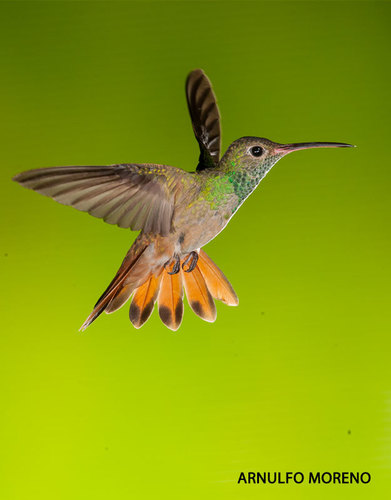
Buff-bellied Hummingbird
Amazilia yucatanensis
A splash of cinnamon and emerald, the Buff-bellied Hummingbird is the largest hummingbird regularly seen in Texas and a bold visitor to backyard gardens. Known for its feisty personality and distinctive red bill, this stunning bird brings a touch of tropical flair to the Gulf Coast.
Quick Identification
Size
Length: 10-11 cm (3.9-4.3 in); Wingspan: 14.5 cm (5.7 in); Weight: 2.9-4.7 g (0.1-0.17 oz)
Colors
Metallic olive-green upperparts, brilliant green throat and breast, distinctive buff or cinnamon-colored belly, and a rufous tail. The bill is notably red with a dark tip.
Key Features
- Cinnamon-buff belly and undertail coverts
- Bright red bill with a dark tip
- Rufous notched tail visible in flight
- Metallic green throat and chest
When You’ll See Them
Geographic range
Where Does the Buff-bellied Hummingbird Live?
Native to North and Central America, the Buff-bellied Hummingbird primarily resides along the Gulf Coast of Mexico and the Yucatán Peninsula, extending into northern Guatemala and Belize. In the United States, it is a signature species of the lower Rio Grande Valley in Texas, where it remains year-round. Interestingly, this species exhibits an unusual 'reverse migration,' with some individuals wandering northeast along the Gulf Coast toward Louisiana, Mississippi, and Florida during the winter months.
Basemap © OpenStreetMap contributors
Behavior
The Buff-bellied Hummingbird is known for its bold and often aggressive personality. Unlike many smaller hummingbirds, it doesn't hesitate to defend its territory, frequently chasing away larger birds and other hummingbirds from its favorite nectar sources or feeders. They are highly vocal, often giving a sharp 'tsip' call while foraging or defending their turf.
In backyard settings, they are remarkably curious and can become accustomed to human presence. They spend much of their day patrolling a specific circuit of flowers, a behavior known as 'traplining,' though they will also hover and 'glean' small insects and spiders from foliage or snatch them mid-air. During the winter, while some stay put in their core range, others are famous for wandering northeast along the U.S. Gulf Coast, making them a sought-after visitor for birdwatchers in Louisiana and Florida.
EverydayEarth exclusive
Camera Tips
To capture the stunning iridescence of the Buff-bellied Hummingbird, placement is everything. Position your camera approximately 12 to 18 inches away from a nectar feeder or a cluster of native flowering plants like Turk's Cap or Firebush. Because these birds are quite territorial, they often have a 'favorite' perch nearby—look for a thin, bare branch within 10 feet of the food source and aim a second camera there to capture resting shots. Angle the camera so the sun is behind the lens; this ensures the light hits the metallic green feathers and the bright red bill, preventing the bird from appearing as a dark silhouette.
Using a camera with a high-speed trigger or a dedicated 'bird' mode is essential. These hummingbirds move incredibly fast, so a shutter speed of at least 1/2000th of a second (if manual settings are available) or a high-frame-rate video setting (60fps or higher) is necessary to freeze the wing motion. If your camera supports it, use a 'Pre-capture' feature that saves images from a second before the trigger, as these birds often dart in and out of the frame faster than a standard PIR sensor can react.
For the best results, focus on the early morning hours just after sunrise and the 'golden hour' before sunset, when their activity peaks and the light is softest. If you are in the Gulf Coast region outside of South Texas, keep your cameras active during the late autumn and winter months. The Buff-bellied Hummingbird is one of the few species that 'migrates' toward the coast during the cold season, making it a prime candidate for winter backyard photography when other migratory birds have headed further south.
Similar Species
Species that look similar or are commonly confused with Buff-bellied Hummingbird.
Frequently Asked Questions
Record Buff-bellied Hummingbird at your habitat
Connect a camera to start building your own species record — AI identifies every visitor automatically.