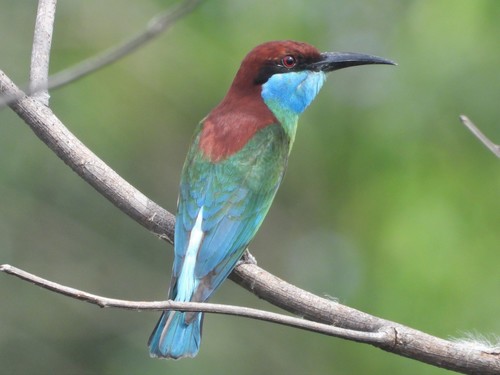
Blue-throated Bee-eater
Merops viridis
A jewel of the Asian lowlands, the Blue-throated Bee-eater combines dazzling chestnut and emerald plumage with incredible aerial agility. Watch these social hunters transform your backyard sky into a stage for their acrobatic insect pursuits.
Quick Identification
Size
27 to 30 cm (10.5–12 in) in length including tail streamers; wingspan of 30–35 cm (12–14 in); weight 28–45 g (1–1.6 oz)
Colors
Adults feature a rich chestnut crown and nape, a signature neon-blue throat, and vibrant emerald-green wings. Juveniles are mostly dull green.
Key Features
- Elongated central tail feathers (streamers)
- Vibrant sky-blue throat patch
- Rich chestnut-colored crown and nape
- Slender, slightly decurved black bill
When You’ll See Them
Geographic range
Where Does the Blue-throated Bee-eater Live?
The Blue-throated Bee-eater is a flagship species of Southeast Asia, thriving across a broad swath of the continent from southern China and Vietnam down through the Malay Peninsula. They are found extensively throughout the archipelagos of Indonesia, the Philippines, and Singapore, where they favor coastal regions and lowland plains. While equatorial populations remain in their territories year-round, northern birds migrate southward during the winter months to seek warmer tropical climates.
Basemap © OpenStreetMap contributors
Behavior
The Blue-throated Bee-eater is a highly social and acrobatic bird, often seen perched on exposed branches, fences, or power lines. They are master aerialists, launching sudden, sweeping sorties to snatch flying insects from the air with an audible snap of the beak. After a successful hunt, they return to a favorite perch to 'process' their prey, which involves vigorously rubbing the insect against the branch to remove the stinger and toxins before swallowing it whole.
These birds are colonial by nature, often congregating in large groups to forage and nest. They have a rich repertoire of liquid, rolling calls that allow them to maintain contact within the flock, especially when moving through dense canopy or during their seasonal migrations. While they are generally wary of humans, they have adapted well to suburban environments where parks and gardens provide ample hunting grounds and open perches.
EverydayEarth exclusive
Camera Tips
To capture high-quality footage of the Blue-throated Bee-eater, look for their 'sentinel perches.' These birds are creatures of habit and will return to the same exposed, high-visibility branch or wire multiple times an hour to scan for prey. Mount your AI camera on a tripod or tree trunk at a height of 5 to 10 feet, aimed at a clear branch with a distant, soft background. This setup ensures the camera's focus remains on the bird's vibrant colors rather than the foliage behind it.
Because these birds are incredibly fast flyers, you should use the highest possible shutter speed setting on your camera to avoid motion blur during take-offs. If your camera supports burst mode or high-frame-rate video, enable it to capture the split-second 'bee-whacking' behavior on the branch. Position the camera so it faces away from the sun—preferably facing North or South—to ensure the bird's chestnut nape and blue throat are fully illuminated by natural light rather than silhouetted.
While you cannot easily bait these birds with traditional feeders, you can attract them by maintaining an insect-friendly backyard. Avoid pesticides and plant native flowering species that attract bees and dragonflies, which serve as a natural lure. During the breeding season (April through July), keep an eye out for small burrows in sandy soil or embankments. Placing a camera 15-20 feet away from these nesting sites can provide a fascinating look at their social interactions and chick-rearing, though you must be careful never to disturb the nest site itself.
Similar Species
Species that look similar or are commonly confused with Blue-throated Bee-eater.
Frequently Asked Questions
Record Blue-throated Bee-eater at your habitat
Connect a camera to start building your own species record — AI identifies every visitor automatically.