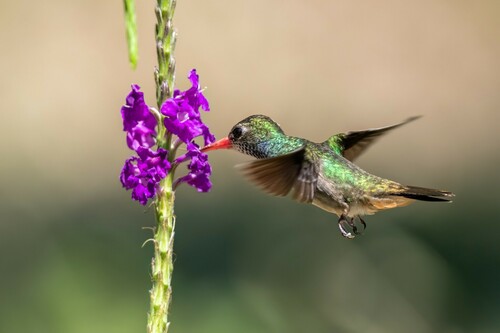
Blue-throated Goldentail
Chlorestes eliciae
With its shimmering violet throat and a tail that glows like a freshly minted coin, the Blue-throated Goldentail is a crown jewel of the Central American lowlands. This spirited hummingbird brings a splash of metallic brilliance to any tropical backyard or forest edge.
Quick Identification
Size
Length: 8.5–9 cm (3.3–3.5 in); Wingspan: approx 11-12 cm (4.3-4.7 in); Weight: 3–4 g (0.1–0.14 oz)
Colors
Metallic green upperparts with a glittering violet-blue throat. The tail is a striking metallic golden-bronze or coppery-orange. The bill is bright red with a distinct black tip.
Key Features
- Glittering violet-blue throat bib
- Shimmering coppery-gold tail feathers
- Bright red bill with a small black tip
- Green crown and metallic upperparts
When You’ll See Them
Geographic range
Where Does the Blue-throated Goldentail Live?
This stunning hummingbird is native to the tropical reaches of Central America and the very northern edge of South America. Its core range extends from southern Mexico through Belize, Guatemala, Honduras, Nicaragua, Costa Rica, and Panama, reaching its southernmost limit in northwestern Colombia. It is primarily a lowland species, found on both the Caribbean and Pacific slopes in regions where dense tropical forests meet coastal plains.
Basemap © OpenStreetMap contributors
Behavior
The Blue-throated Goldentail is a spirited and territorial hummingbird common in the humid lowlands of Central America. While it often dwells in the forest canopy, it is a frequent visitor to forest edges and garden clearings where nectar is abundant. These birds are known for their 'pugnacious' nature, often aggressively defending a high-quality patch of flowers or a feeder from other hummingbirds, regardless of size.
During the breeding season, males are known to form small leks—groups where they gather to sing and attract females. Their song is a series of thin, high-pitched metallic notes delivered from a low, shaded perch. Unlike many North American hummingbirds that undergo long migrations, the Blue-throated Goldentail is largely a resident, though it may move locally to follow the peak blooming cycles of various tropical plants.
EverydayEarth exclusive
Camera Tips
To capture the Blue-throated Goldentail on camera, positioning is everything. Place your bird camera near red or orange tubular flowers, such as Heliconia, Hibiscus, or Shrimp Plants, which are their natural favorites. Aim the lens at a height of 3 to 5 feet off the ground, as this species often forages in the mid-story and shrub layer. Ensure the camera is angled so the sun is behind the lens; this is crucial for capturing the iridescent gold of the tail and the blue of the throat, which can look dull or black in shadows.
Using a high-quality nectar feeder can also lure them in, especially if the feeder includes perches. Blue-throated Goldentails often prefer to sit while drinking rather than hovering constantly. Set your camera’s trigger speed to the fastest possible setting—ideally under 0.1 seconds—to catch their rapid movements. If your camera allows for video, a high frame rate (60fps or higher) is recommended to slow down their wing beats during playback for a truly cinematic look.
Because they are most active during the cooler parts of the day, focus your monitoring between dawn and 9:00 AM. In backyards, they are more likely to visit if there is a water feature nearby, like a misting fountain or a shallow birdbath. They love to fly through fine mists to bathe and preen. If you are using a trail camera in a more wooded area, look for 'lekking' sites where males gather to sing; these are often low branches about 1-2 meters high in shaded undergrowth near forest gaps.
Similar Species
Species that look similar or are commonly confused with Blue-throated Goldentail.
Rufous-tailed Hummingbird
The Rufous-tailed has a duller, reddish-brown tail without the metallic gold sheen and lacks the brilliant violet-blue throat patch.
Blue-headed Sapphire
This species has a much more extensive blue coloring covering the entire head, rather than just the throat and upper breast.
Frequently Asked Questions
Record Blue-throated Goldentail at your habitat
Connect a camera to start building your own species record — AI identifies every visitor automatically.