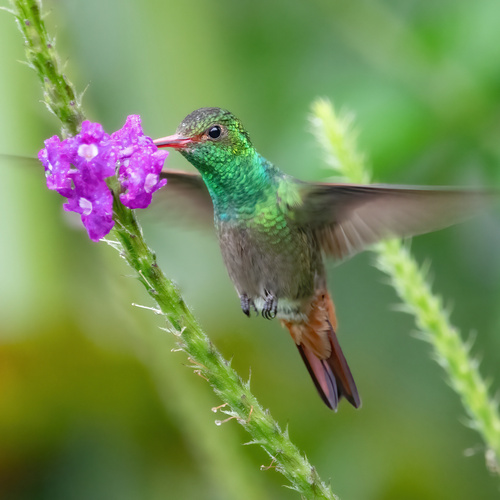
Rufous-tailed Hummingbird
Amazilia tzacatl
The spirited guardian of the tropical garden, the Rufous-tailed Hummingbird is a flash of emerald and copper. Bold, territorial, and remarkably adaptable, it is the most frequent visitor to backyard feeders from Mexico to Ecuador.
Quick Identification
Size
Length: 8-11 cm (3.1-4.3 in); Wingspan: 10-12 cm (4-4.7 in); Weight: 4.5-5.5 g (0.16-0.19 oz)
Colors
Metallic golden-green upperparts and throat; pale gray or brownish belly; distinctive reddish-brown (rufous) tail. The bill is notably pinkish-red with a dark tip.
Key Features
- Bright rufous-colored tail and vent
- Pinkish-red bill with a black tip
- Iridescent green throat and breast
- Highly aggressive and territorial behavior
When You’ll See Them
Behavior
The Rufous-tailed Hummingbird is widely regarded as one of the most aggressive and dominant hummingbird species within its range. Known as a 'feeder bully,' it will vigorously defend a rich nectar source or a backyard feeder against all intruders, including larger bird species and even butterflies. You will often hear them before you see them, as they emit a sharp, persistent 'tik' or 'chi-it' call while patrolling their territory.
Unlike more reclusive forest species, these birds thrive in human-altered landscapes. They are highly inquisitive and may hover just a few feet away from humans to inspect bright clothing or equipment. Their flight is characterized by rapid, jerky movements as they zip between flowers, often returning to the same few perching twigs to scan for rivals.
EverydayEarth exclusive
Camera Tips
To capture high-quality footage of the Rufous-tailed Hummingbird, positioning is everything. Place your camera 2 to 3 feet away from a sugar-water feeder or a cluster of red tubular flowers like Salvia or Firebush. Because this species is highly territorial, identify its favorite 'guard perch'—usually a bare, prominent twig nearby—and aim a second camera there. You'll catch stunning still shots of the bird while it rests and scans its territory between feeding sessions.
Lighting is the biggest challenge when capturing iridescent feathers. For the most vibrant greens and bronzes, ensure the sun is behind the camera lens, illuminating the bird’s chest and throat directly. If your camera allows for manual settings, use a very high shutter speed (1/2000s or faster) to freeze the wing motion, or use high-frame-rate video (60fps+) to create beautiful slow-motion sequences of their hovering and 'tail-fanning' displays.
Don't forget the water! Rufous-tailed Hummingbirds love to bathe, especially during the heat of the afternoon. A shallow birdbath with a solar-powered fountain or a 'mister' attachment on a garden hose is an irresistible lure. Position your camera to capture the splash zone, as their bathing behavior is incredibly energetic and makes for unique, high-engagement content for your wildlife collection.
Similar Species
Species that look similar or are commonly confused with Rufous-tailed Hummingbird.
Cinnamon Hummingbird
The Cinnamon Hummingbird has a completely orange-brown underside, whereas the Rufous-tailed has a metallic green throat and gray belly.
Buff-bellied Hummingbird
The Buff-bellied has a similar red bill but features a pale buffy-colored belly instead of the Rufous-tailed's darker gray belly.
Frequently Asked Questions
Record Rufous-tailed Hummingbird at your habitat
Connect a camera to start building your own species record — AI identifies every visitor automatically.