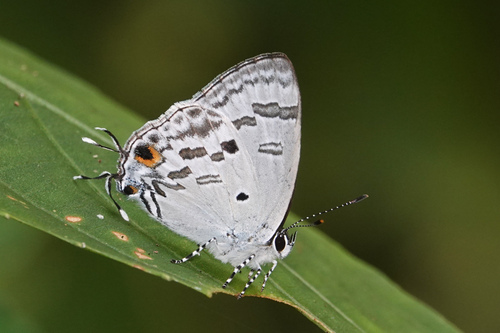
Blue Tit
Hypolycaena kina
Though it shares a name with a famous bird, the Blue Tit butterfly is a Himalayan treasure. This small, iridescent marvel flits through South Asian forests, showing off brilliant azure wings and delicate 'tails' that dance in the sunlight.
Quick Identification
Size
Wingspan of 25–32 mm (1.0–1.25 inches)
Colors
Males feature a brilliant sky-blue upperside with wide black borders; females are predominantly brown with blue scales limited to the wing bases.
Key Features
- Two delicate, thread-like tails on each hindwing
- Pale iridescent blue upperside with broad black apical borders
- Distinctive orange-brown submarginal bands on the pale grey underside
- Small, slender body typical of 'hairstreak' butterflies
When You’ll See Them
Geographic range
Where Does the Blue Tit Live?
This enchanting butterfly is native to the hilly regions of South and Southeast Asia. Its primary range stretches across the Himalayan foothills, from northern India and Nepal through Bhutan and into Myanmar. It is also frequently recorded in the highlands of Thailand, Laos, and Vietnam, where it flourishes in moist, high-altitude forest ecosystems.
Basemap © OpenStreetMap contributors
Behavior
The Blue Tit is a fast and energetic flyer, often seen darting through the mid-canopy or flitting along the edges of forest trails. It belongs to the Lycaenidae family, a group known for complex wing patterns and a tendency to sit with wings tightly closed when at rest. While they are relatively solitary in flight, males are known to descend to the forest floor in small groups to engage in 'mud-puddling,' where they sip mineral-rich moisture from damp earth or stones.
Unlike many garden butterflies that prefer open meadows, the Blue Tit is a forest specialist. It relies on the dappled light of the understory and is most active during the warmest parts of the day. In backyard settings that border woodland or hilly terrain, they may visit for nectar, but they generally remain shy and will vanish into the foliage if they sense sudden movement.
EverydayEarth exclusive
Camera Tips
Capturing the Blue Tit butterfly requires a specialized approach due to its small size and preference for forest light. To photograph them successfully, place your camera near known 'mud-puddling' spots—these are typically damp, sandy patches near forest streams or puddles on trail edges. Because they are low-flying when seeking minerals, mount your camera just 12 to 18 inches above the ground, angled slightly upward to catch the blue sheen on the upperside of their wings if they open them.
For backyard enthusiasts, the best strategy is to plant or place orchid species (like Rhynchostylis), which serve as both a nectar source and a larval host for this species. Use a camera with a dedicated macro mode or a high-resolution sensor that allows for significant cropping. A fast shutter speed (at least 1/1000s) is necessary to freeze the motion of their rapid, fluttering wings.
Since these butterflies are cold-blooded, they are most predictable on sunny mornings between 10 AM and 1 PM when they are baskng to regulate their temperature. If your camera has a time-lapse feature, set it to trigger every 5-10 seconds during these peak hours. To increase your chances of a close-up, you can create a 'butterfly station' by placing a small piece of damp, salted earth or a piece of overripe fruit within the focal range of your lens.
Similar Species
Species that look similar or are commonly confused with Blue Tit.
Frequently Asked Questions
Record Blue Tit at your habitat
Connect a camera to start building your own species record — AI identifies every visitor automatically.