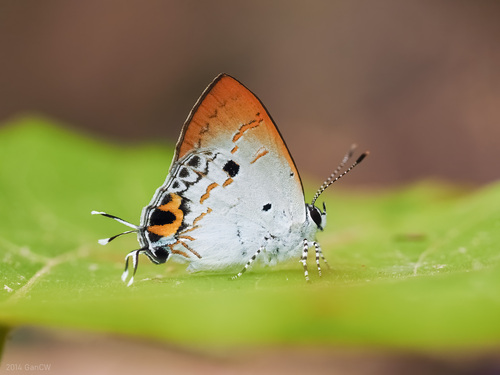
Orchid Tit
Insects diurnal

Orchid Tit

Hypolycaena othona

A gem of the tropical garden, the Orchid Tit is a master of disguise with delicate tails and striking orange-banded wings. Despite its bird-like name, this tiny butterfly is a specialized inhabitant of the orchid world.

0 Sightings
0 Habitats

Quick Identification

straighten

Size

Wingspan of 24–30 mm (0.9–1.2 inches)

palette

Colors

Upperside is silky blue with broad black borders in males, while females are duller brown. The underside is creamy-white with distinct orange-yellow transverse bands and black spots near the tails.

visibility

Key Features

  • Two pairs of delicate, thread-like tails on each hindwing
  • Bright orange-yellow bands on a white underside
  • Blue basal scales visible on the upperside of males
  • Small orange-ringed black eyespots near the tail base

When You’ll See Them

schedule
Activity pattern diurnal
brightness_5
Peak hours 9:00 AM – 1:00 PM
calendar_month
Season Year-round in tropical climates, with peaks following the monsoon season (June–October)
restaurant
Diet Adults feed on the nectar of small wildflowers. The larvae are specialists that feed exclusively on the flowers, buds, and young shoots of various orchid species.
park
Habitat Found in moist deciduous forests, forest edges, and suburban gardens containing orchids or dense tropical foliage.

bar_chart
Loading activity data...

Behavior

The Orchid Tit is a delicate and fast-flying butterfly that belongs to the 'Blues' family. They are known for their 'false head' defense mechanism; when perched, they frequently twitch their hindwings, making their moving tails and eyespots resemble a head. This behavior misdirects predators like jumping spiders and small birds toward the wing tips rather than the butterfly's actual body.

These butterflies are highly specialized and are almost always found in close proximity to their host plants—various species of orchids. While they are energetic fliers, they tend to stay in the shaded understory or mid-canopy where orchids naturally grow, making them a treat for patient backyard observers who maintain tropical or subtropical gardens.

photo_camera EverydayEarth exclusive

Camera Tips

To capture the Orchid Tit, camera placement is everything. These butterflies are rarely found away from their host plants, so you should focus your lens specifically on orchid flower spikes or nearby nectar-rich plants like Lantana. Because they are small, ensure your camera is set to a macro or close-up mode if available, and mount it roughly 12-24 inches from the target flower to capture fine details of the wing patterns.

Lighting is crucial for this species. Their blue scales are iridescent, meaning they look best in bright, indirect morning light. Position your camera so it is not facing directly into the sun, which can wash out the delicate white and orange patterns on their underside. A side-lit angle around 10:00 AM will help highlight the texture of their wings and the movement of their 'tails' as they nectar.

Since these butterflies are quite skittish, use a high-speed trigger setting. They often land for only a few seconds to probe a flower before darting away. If you are using a trail camera for backyard wildlife, look for a model with a fast 'trigger speed' (under 0.3 seconds) to ensure you don't just get a shot of an empty flower. Placing a shallow water dish with a few stones (a butterfly puddling station) near your orchids can also encourage them to land and stay still for longer periods.

Frequently Asked Questions

Orchid Tits are most active during the morning and early afternoon, typically from 9:00 AM to 1:00 PM, when the sun is warm enough for flight but before the intense heat of late afternoon.
The best way to attract Orchid Tits is to grow their host plants, which are various species of orchids. Providing nectar-rich flowers like Heliotrope or Lantana will also encourage adults to visit your garden.
Adult Orchid Tits drink nectar from small blossoms. Their caterpillars are unique because they feed on the buds and flowers of orchids, which is how the species earned its common name.
They can be common in suburban areas within their range (Asia), particularly in neighborhoods with lush gardens, nurseries, or homes that keep outdoor orchid collections.
Look at the underside of the wings; the Orchid Tit has distinct orange-yellow bands across a white background and two pairs of tails. Other similar 'Tits' may have different band colors or only one pair of tails.

Record Orchid Tit at your habitat

Connect a camera to start building your own species record — AI identifies every visitor automatically.

Join free Identify a photo