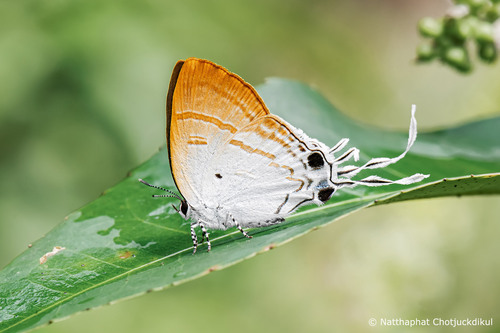
Fluffy Tit
Zeltus amasa
With its ethereal white tails and delicate blue wings, the Fluffy Tit is one of the most enchanting butterflies you can find in a tropical garden. This small but striking insect adds a touch of magic to the forest floor as it dances through the dappled light.
Quick Identification
Size
Wingspan of 28–32 mm (1.1–1.3 inches); total length including tails can reach up to 45 mm (1.8 inches).
Colors
Males feature a pale blue and black upperside; females are predominantly dark brown. Both have greyish-white undersides with distinct dark bands and long, white filamentous tails.
Key Features
- Exceptionally long, white thread-like tails on the hindwings
- Pale blue upperside in males
- Greyish-white underside with thin dark bands
- Fluttery, low-to-the-ground flight pattern
When You’ll See Them
Behavior
The Fluffy Tit is a jewel of the forest understory, known for its elegant and somewhat erratic flight. Despite its delicate appearance, it is a hardy butterfly often seen flitting around moist, shaded areas. Males are particularly social and can frequently be found engaged in 'puddling'—gathering around damp soil, wet rocks, or even bird droppings to extract essential salts and minerals required for reproduction.
Unlike many other butterflies that prefer high canopy life, the Fluffy Tit stays relatively low to the ground, usually perching on the undersides of leaves with its wings closed. This habit makes them a delightful discovery for backyard observers in tropical regions. While they aren't aggressive, they are quite alert and will quickly flutter away if they perceive a shadow or sudden movement, using their long tails to mimic antennae and confuse predators about which end is the head.
EverydayEarth exclusive
Camera Tips
Capturing the Fluffy Tit on an AI-powered camera requires a specific focus on their unique perching habits. Because these butterflies tend to stay low to the ground—usually between 1 and 3 feet—your camera should be mounted on a low tripod or a short stake rather than high on a tree trunk. Angle the lens slightly upward if placing it beneath broad-leaved plants, as they love to rest on the underside of foliage to hide from the midday sun and predators.
The best 'lure' for a Fluffy Tit isn't always a flower. If you have a male in the area, creating a 'mud puddle' station is incredibly effective. Find a shaded patch of dirt, keep it consistently moist, and perhaps add a tiny pinch of sea salt or a small amount of organic compost. Position your camera about 1.5 to 2 feet away from this spot with a high-resolution setting to capture the incredible detail of their white, hair-like tails.
Lighting is your biggest challenge and best friend. These butterflies thrive in dappled sunlight. Set your camera's trigger sensitivity to high, as their flight is very light and might not always trip a standard motion sensor. Using a 'Burst' or 'Photo + Video' mode is recommended so you can catch the moment they land and begin vibrating their hindwings—a common behavior used to draw a predator's attention away from their vulnerable body.
During the rainy season, focus on clear mornings immediately after a downpour. This is when they are most likely to emerge to dry their wings and seek out fresh mineral deposits. If your camera allows for manual focal ranges, set it to a narrow field to ensure the butterfly is in crisp focus while the background stays soft and blurred, highlighting the delicate 'fluff' for which they are named.
Similar Species
Species that look similar or are commonly confused with Fluffy Tit.
Common Tit
The Common Tit lacks the exceptionally long, dramatic white tails of the Fluffy Tit and has a more uniform brownish-grey underside.
Orchid Tit
The Orchid Tit is much smaller and features more intricate, darker patterns on the underside of its wings compared to the cleaner look of the Fluffy Tit.
Frequently Asked Questions
Record Fluffy Tit at your habitat
Connect a camera to start building your own species record — AI identifies every visitor automatically.