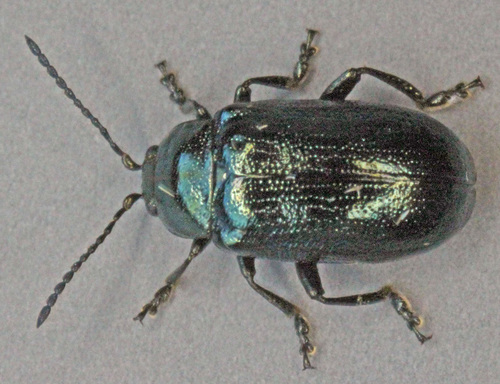
Blue Willow Beetle
Phratora vulgatissima
The Blue Willow Beetle is a miniature marvel of the insect world, sporting a metallic cobalt coat that shimmers in the sun. Often found in social clusters on riverside willows, this tiny leaf-eater is a vibrant indicator of a healthy wetland ecosystem.
Quick Identification
Size
Small and compact, ranging from 4 to 5 mm (0.16 to 0.20 inches) in length.
Colors
Brilliant metallic blue, occasionally shifting to violet or dark green; the underside and legs are typically dark or black.
Key Features
- Strongly metallic blue or violet elytra (wing cases)
- Oval-shaped, convex body profile
- Punctured rows of tiny pits along the wing cases
- Short, dark antennae with slightly thickened segments toward the tips
When You’ll See Them
Geographic range
Where Does the Blue Willow Beetle Live?
The Blue Willow Beetle is native to the vast Palearctic region, stretching across the entirety of Europe and northern Asia. It is widely distributed from the United Kingdom and Scandinavia in the west, through central Europe and Russia, and extending as far east as temperate China. While it has not been widely introduced outside its native range, it remains one of the most common leaf beetles within its established Eurasian territory.
Basemap © OpenStreetMap contributors
Behavior
The Blue Willow Beetle is a highly specialized herbivore that spends its entire life cycle in close proximity to its host plants. Adults emerge from their winter hibernation sites—usually tucked deep within the crevices of tree bark or under leaf litter—in late spring as temperatures rise. Once active, they are social feeders, often congregating in small groups on the tender young leaves of willow and poplar trees to feed and find mates.
A unique aspect of their behavior is the defensive strategy employed by their larvae. When threatened, the larvae can exude droplets of a pungent fluid containing salicylaldehyde, derived from the salicylic acid in their willow diet. This chemical defense is remarkably effective at deterring predators like ants and birds. Adults are also known for their 'sun-loving' nature, appearing most active on bright, calm days when they can be seen crawling rapidly over foliage.
EverydayEarth exclusive
Camera Tips
Capturing the Blue Willow Beetle on camera requires a dedicated macro setup because of their diminutive size. Standard trail cameras will likely miss the detail unless they are modified with a close-up lens or positioned extremely close—within 5 to 10 inches—of a willow branch. Focus your efforts on the 'growing tips' of willow trees, as these beetles prefer the softest, newest leaves for feeding and egg-laying.
Lighting is the most critical factor for a successful 'shot.' To capture the stunning metallic blue sheen, you need bright, directional light. Setting up your camera in an area that catches the mid-morning sun will help the beetle's iridescent elytra pop against the green foliage. If you are using an AI-powered camera with adjustable settings, try increasing the shutter speed to freeze the movement of the beetle as it scurries across the leaf surface.
Look for evidence of 'skeletonization' on willow leaves—where the beetle has eaten the leaf tissue but left the veins behind—and place your camera near these active feeding zones. Since these beetles are sensitive to vibrations and shadows, mounting your camera on a stable branch and using a remote trigger or time-lapse mode can help you capture natural behaviors without startling them. Peak activity occurs on warm, windless days when the beetles are most likely to be out in the open rather than hiding under leaves.
Similar Species
Species that look similar or are commonly confused with Blue Willow Beetle.
Frequently Asked Questions
Record Blue Willow Beetle at your habitat
Connect a camera to start building your own species record — AI identifies every visitor automatically.