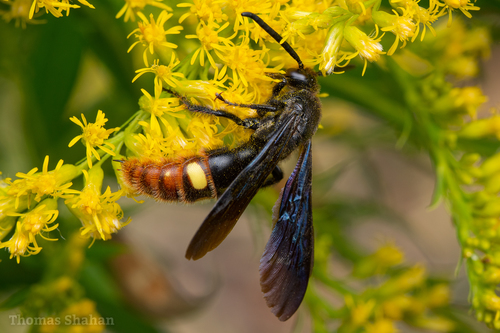
Blue-winged Scoliid Wasp
Scolia dubia
With shimmering indigo wings and a helpful habit of hunting garden pests, the Blue-winged Scoliid Wasp is a gardener's best friend. This striking solitary wasp is more interested in wildflowers than bothering people.
Quick Identification
Size
20-25 mm (0.8-1.0 inches) in length
Colors
Deep black body with metallic blue-violet iridescent wings; the abdomen features two prominent yellow spots and a fuzzy reddish-brown tip.
Key Features
- Shimmering metallic blue-purple wings
- Two distinct yellow spots on the mid-abdomen
- Fuzzy reddish-brown hairs at the tip of the abdomen
- Low, figure-eight flight pattern over turfgrass
When You’ll See Them
Geographic range
Where Does the Blue-winged Scoliid Wasp Live?
Native to North America, the Blue-winged Scoliid Wasp is a common sight across the eastern and central United States. Its core range extends from southern New England down through Florida and stretches westward toward the Great Plains and the Rocky Mountains. These wasps are particularly abundant in suburban environments where manicured lawns provide ample breeding grounds for the beetle grubs they rely on for reproduction.
Basemap © OpenStreetMap contributors
Behavior
The Blue-winged Scoliid Wasp is a gentle giant of the garden. Unlike social wasps such as yellowjackets, these are solitary creatures and lack the 'defend the hive' instinct, making them exceptionally safe to have around humans and pets. They spend much of their day flying low over lawns in a rhythmic figure-eight pattern, which is a tell-tale sign that they are hunting for beetle larvae beneath the soil.
Once a female locates a host through scent, she digs into the earth to find a grub—typically a Green June Beetle or Japanese Beetle larva. She stings the grub to paralyze it, lays a single egg on its body, and then moves on. This unique lifecycle makes them an invaluable natural ally for homeowners looking to control lawn pests without the use of harsh chemicals.
EverydayEarth exclusive
Camera Tips
Capturing the Blue-winged Scoliid Wasp requires a focus on their specific foraging habits. Because they spend much of their time flying just inches above the grass in search of grubs, mount your camera on a low-profile stake or a small tripod only 6 to 12 inches off the ground. Angle the lens slightly upward to catch the iridescent sheen of their blue wings against the sky or downward to capture their scanning flight behavior over the turf.
To attract them specifically for a close-up, plant or place a lure of nectar-rich flowers. Late-summer bloomers like Goldenrod (Solidago), Mountain Mint (Pycnanthemum), or Sedum are irresistible to adults. Position your camera in macro mode if available, or use a high-frame-rate setting (60fps or higher) to capture the rapid movement of their wings, which can appear almost black until the sunlight hits the metallic blue scales at just the right angle.
Timing is everything with this species. They are heat-loving insects, so focus your recording efforts during the hottest parts of the day in late August and early September. They are most active when the sun is high, typically between 11 AM and 3 PM. If you notice them performing their rhythmic figure-eight dance over a specific patch of your lawn, that is the perfect spot for a multi-day time-lapse or motion-triggered setup. Using a camera with a fast trigger speed is essential, as their low-altitude flight is surprisingly quick.
Similar Species
Species that look similar or are commonly confused with Blue-winged Scoliid Wasp.
Frequently Asked Questions
Record Blue-winged Scoliid Wasp at your habitat
Connect a camera to start building your own species record — AI identifies every visitor automatically.