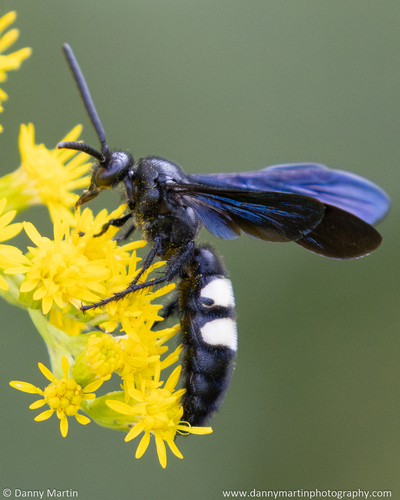
Double-banded Scoliid Wasp
Scolia bicincta
A striking midnight-black pollinator with twin ivory bands, the Double-banded Scoliid Wasp is the gardener's secret ally. This gentle giant patrols our lawns in late summer, providing natural pest control and a splash of iridescent beauty.
Quick Identification
Size
20-25 mm (0.8 to 1.0 inches) in length
Colors
Jet black body with two distinct white or pale yellow transverse bands on the abdomen; wings are dark smoky-black with a blue or purple iridescent sheen.
Key Features
- Two prominent horizontal white/yellow bands on the abdomen
- Dark, smoky wings with metallic blue or purple iridescence
- Robust, hairy body typical of scoliid wasps
- Low-flying, figure-eight flight pattern over lawns
When You’ll See Them
Geographic range
Where Does the Double-banded Scoliid Wasp Live?
Native to North America, the Double-banded Scoliid Wasp is primarily found throughout the Eastern and Central United States. Its range extends from the Atlantic coast westward to the Great Plains, and as far north as Southern Ontario, Canada, stretching down through the Gulf States into parts of Mexico. They are particularly prevalent in regions with temperate climates where sandy or loamy soils support high populations of their beetle hosts.
Basemap © OpenStreetMap contributors
Behavior
The Double-banded Scoliid Wasp is a solitary, non-aggressive insect that provides an essential service to gardeners. Unlike social wasps like yellowjackets, they do not live in colonies or defend a communal nest. Most of their daily activity involves foraging on nectar-rich flowers or performing a characteristic low-altitude flight over grassy areas. This zig-zagging flight pattern is actually a hunting mission; females use their sensitive antennae to detect the scent of scarab beetle larvae, such as June bug or Japanese beetle grubs, living underground.
When a female locates a host grub, she digs into the soil, stings the larva to paralyze it, and lays a single egg on its body. The wasp larva then hatches and consumes the grub, acting as a natural form of pest control. These wasps are remarkably docile toward humans and will generally only sting if stepped on or handled roughly. They are often seen in late summer, coinciding with the life cycles of the beetles they parasitize.
EverydayEarth exclusive
Camera Tips
To capture the Double-banded Scoliid Wasp on your backyard camera, focus on late-summer blooms. These wasps are particularly attracted to flat-topped flower clusters like Goldenrod (Solidago), Mountain Mint (Pycnanthemum), and Sedum. Place your camera on a garden stake or small tripod just 12-24 inches away from these flowers. Since these wasps are active and fast, use a camera with a high-speed trigger or set it to record short video clips to ensure you catch the moment they land.
If you want to film their unique hunting behavior, position a camera low to the ground (about 6 inches high) facing a patch of lawn where you have noticed them flying in patterns. Use a downward angle to capture the 'scanning' flight they use to find grubs. Because their most striking feature is the blue-purple iridescence of their wings, try to position the camera so the sun is behind you, illuminating the wasp's back and wings for maximum color vibrance.
Avoid using artificial baits, as these wasps are not attracted to sugar water or meat like social wasps. Instead, provide a shallow water dish with stones for landing—this 'bee bar' can be a great secondary location for camera placement. The best footage is usually captured on bright, calm days between 10 AM and 2 PM when the wasps are most energetic and the lighting is optimal for high-shutter-speed captures.
Similar Species
Species that look similar or are commonly confused with Double-banded Scoliid Wasp.
Frequently Asked Questions
Record Double-banded Scoliid Wasp at your habitat
Connect a camera to start building your own species record — AI identifies every visitor automatically.