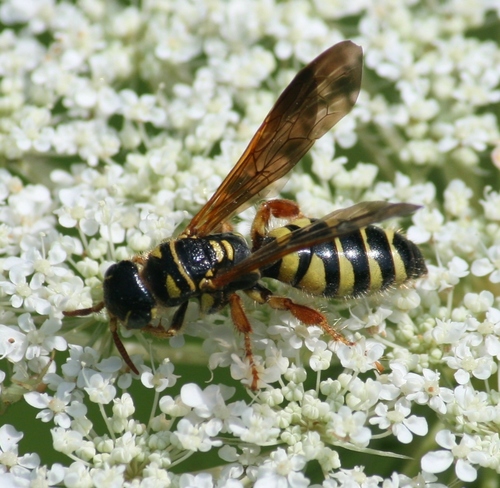
Five-banded Thynnid Wasp
Myzinum quinquecinctum
A striking ally for any gardener, the Five-banded Thynnid Wasp is a master hunter of lawn pests. With its glossy black-and-yellow bands and docile nature, this solitary wasp is a fascinating pollinator to discover in your own backyard.
Quick Identification
Size
12–22 mm (0.5–0.9 inches) in length
Colors
Glossy black body with five prominent, transverse yellow bands on the abdomen. Wings are typically smoky or brownish-tinted.
Key Features
- Five distinct yellow bands across a black abdomen
- Long, slender cylindrical body shape
- Females have spiny legs for digging
- Males have a distinctive upward-curved hook at the tip of the abdomen
When You’ll See Them
Geographic range
Where Does the Five-banded Thynnid Wasp Live?
Native to the North American continent, the Five-banded Thynnid Wasp is found across a wide expanse east of the Rocky Mountains. Its range stretches from southern Canada down through the eastern and central United States, reaching as far south as the Gulf Coast. It is a common sight in the Great Lakes region and throughout the Atlantic states where open grasslands and suburban landscapes provide ample habitat.
Basemap © OpenStreetMap contributors
Behavior
The Five-banded Thynnid Wasp is a solitary insect that serves as a beneficial predator in North American ecosystems. Unlike social wasps, they do not live in colonies or defend a central nest, making them very docile and unlikely to sting unless physically handled. They spend much of their adult lives foraging for nectar on wildflowers or scouting the ground for reproductive opportunities.
The most fascinating aspect of their behavior is their reproductive cycle as parasitoids. Female wasps spend considerable time walking or flying low over turf and soil, using their antennae to detect the scent of scarab beetle larvae (commonly known as white grubs) living underground. Once a host is found, the wasp digs into the soil, paralyzes the grub with a sting, and deposits an egg. The developing wasp larva then feeds on the grub, providing a natural and effective form of pest control for lawns and gardens.
EverydayEarth exclusive
Camera Tips
To capture high-quality footage of the Five-banded Thynnid Wasp, focus your camera efforts on late-summer nectar sources. These wasps are particularly fond of flat-topped flower clusters such as Goldenrod (Solidago), Queen Anne's Lace, and Milkweed. Set your camera on a tripod or stable mount roughly 12 to 20 inches from the blossoms. Because these wasps are fast-moving, use a camera setting with a high frame rate or a fast trigger speed to avoid motion blur as they dart between flowers.
Another effective strategy is to place your camera at a very low angle near patches of lawn that show signs of beetle activity (such as small mounds or thinning grass). Females can often be caught on camera performing their 'hunting walk,' where they move methodically across the ground with vibrating antennae. For these ground shots, a wide-angle macro lens is ideal to keep the wasp in focus while capturing the surrounding environment. Ensure the area is well-lit by the sun, as these wasps are most active when temperatures are high.
If you are using an AI-powered camera, set the sensitivity to its highest level to detect the small, quick movements of insects. Since they are attracted to moisture in mid-summer heat, placing a shallow 'bee bar'—a dish of water with pebbles for them to land on—near your target flowers can create a perfect staging area for clear, stationary shots. Avoid using any chemical lures; the natural scent of blooming flowers and the presence of lawn grubs are the best ways to bring them into your camera's field of view.
Similar Species
Species that look similar or are commonly confused with Five-banded Thynnid Wasp.
Noble Scoliid Wasp
Features two large yellow spots on the abdomen rather than five bands, and often has wings with a distinct blue or purple iridescent sheen.
Eastern Yellowjacket
Much stockier build with a broader abdomen and distinct 'anchor' or 'jagged' yellow markings rather than simple transverse bands.
Frequently Asked Questions
Record Five-banded Thynnid Wasp at your habitat
Connect a camera to start building your own species record — AI identifies every visitor automatically.