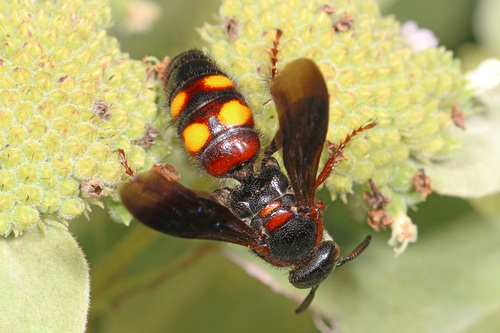
Noble Scoliid Wasp
Scolia nobilitata
A striking native wasp with golden spots and iridescent wings, the Noble Scoliid Wasp is a peaceful garden guardian. This solitary flyer spends its days pollinating flowers and naturally protecting your lawn from pests.
Quick Identification
Size
10–15 mm (0.4–0.6 inches) in length with a similar wingspan
Colors
Jet black body with four distinct yellow or orange spots on the abdomen; wings are dark smoky-brown to blue-black
Key Features
- Four yellow spots on the dorsal side of the abdomen
- Iridescent blue-black smoky wings
- Hairy, robust body typical of scoliid wasps
- Spiny legs used for digging in soil
When You’ll See Them
Geographic range
Where Does the Noble Scoliid Wasp Live?
The Noble Scoliid Wasp is a native resident of North America, found extensively throughout the Eastern and Central United States. Its territory stretches from the Atlantic coast as far west as the Great Plains and Texas. While they thrive in the warmer climates of the Southeast, their range extends northward into the Mid-Atlantic and southern parts of the Great Lakes region, including small populations in southern Ontario, Canada. They are most abundant in areas where sandy soil and healthy turfgrass provide ample habitat for their beetle-grub hosts.
Basemap © OpenStreetMap contributors
Behavior
The Noble Scoliid Wasp is a gentle, solitary giant of the garden world. Unlike social wasps like hornets or yellowjackets, these wasps do not live in colonies and have no nest to defend, making them exceptionally non-aggressive toward humans. They are most frequently observed in late summer, either gliding gracefully over lawns in a unique figure-eight flight pattern or lazily sipping nectar from flat-topped flowers.
Their primary life mission is to locate the larvae of scarab beetles (often called 'white grubs') that live underground. When a female detects a grub, she digs into the soil, paralyzes the larva with a sting, and lays an egg upon it. This makes them an incredible natural ally for homeowners, as they provide free, chemical-free pest control for lawns and gardens. Despite their somewhat imposing appearance, they are beneficial pollinators that play a vital role in the local ecosystem.
EverydayEarth exclusive
Camera Tips
To capture the Noble Scoliid Wasp on camera, your best bet is to focus on 'pollinator hubs' during the hottest part of the day. Mount your camera on a tripod or garden stake just 1–2 feet away from nectar-rich flowers like Mountain Mint, Goldenrod, or Milkweed. These wasps are attracted to the color yellow and white, so focusing on those blooms will increase your chances of a close-up.
Since these wasps are fast and move with jerky, erratic motions, set your AI-powered camera to its highest sensitivity or use a high-speed video mode (60fps or higher). If your camera allows for focal depth adjustments, try to keep the focus tight on the flower head. The iridescence of their wings is best captured in direct, bright sunlight, which is luckily when the wasps are most active.
Another great trick is to place a camera low to the ground near a patch of lawn where you see them flying in low circles. This is their hunting behavior, and you might catch rare footage of a female wasp disappearing into the grass to dig for grubs. Avoid using fast-motion triggers alone; a time-lapse setting that takes a photo every few seconds during the peak hours of 11 AM to 2 PM can often catch these visitors when PIR sensors might miss their small heat signatures.
Similar Species
Species that look similar or are commonly confused with Noble Scoliid Wasp.
Frequently Asked Questions
Record Noble Scoliid Wasp at your habitat
Connect a camera to start building your own species record — AI identifies every visitor automatically.