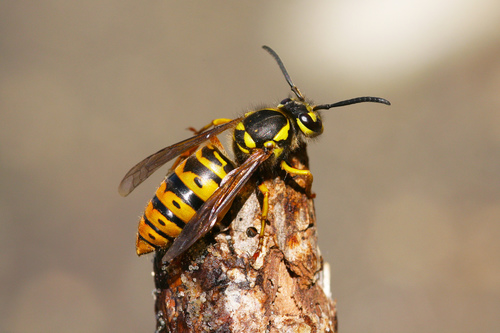
Eastern Yellowjacket
Vespula maculifrons
The industrious architect of the underground, the Eastern Yellowjacket is a vital predator in our backyards that keeps garden pests in check.
Quick Identification
Size
Workers: 10–13 mm (0.4–0.5 in); Queens: 15–19 mm (0.6–0.75 in)
Colors
Bright yellow and black bands; abdomen features distinct black spots and a signature black 'anchor' or 'diamond' mark on the first segment.
Key Features
- Yellow and black banded abdomen
- Nests underground or in dark cavities
- Worker has a black anchor-shaped mark on the base of the abdomen
- Hard, smooth exoskeleton without the dense fuzz of a bee
When You’ll See Them
Geographic range
Where Does the Eastern Yellowjacket Live?
Native to the eastern half of North America, the Eastern Yellowjacket is a dominant presence from the Atlantic coast westward to the Great Plains. Its core territory stretches from Southern Canada through the United States, reaching as far south as Florida and eastern Texas. While it is most concentrated in temperate woodland and suburban environments, it has successfully adapted to almost any landscape where soil conditions allow for subterranean nesting.
Basemap © OpenStreetMap contributors
Behavior
The Eastern Yellowjacket is a highly social insect that operates within a complex colony structure. Led by a single queen, the colony consists of thousands of sterile female workers that handle foraging, nest expansion, and defense. Unlike many other wasps, this species is primarily a ground-nester, often repurposing old rodent burrows or hollow logs to build their intricate paper combs. They are famously protective; if the nest is disturbed, workers will swarm and deliver repeated stings to perceived threats.
As the season progresses, their behavior shifts noticeably. In early summer, they are diligent hunters, clearing gardens of caterpillars and flies to provide protein for their developing larvae. However, by late summer and autumn, their dietary needs change toward carbohydrates. This is when they become most visible to humans, frequently scavenging at picnics, trash cans, and orchards for sugary rewards to sustain the hive through its final cycle.
EverydayEarth exclusive
Camera Tips
Capturing the Eastern Yellowjacket on camera requires a strategy focused on baiting and high-speed settings. To get clear shots, set up a dedicated 'macro station' in a sunny spot. In early summer, use a small piece of canned fish or wet cat food as a lure to attract workers looking for protein. By late summer, switch to a saucer of overripe peaches or sugar water. This keeps the insects stationary long enough for your camera to focus on their intricate markings.
Because these wasps are fast-moving, use a high shutter speed (at least 1/1000s) to freeze their wings in flight. If your camera allows, use a macro lens or a 'close-up' mode to capture the specific black anchor pattern on their abdomen, which is the key to identifying this species. Position your camera on a small tripod about 12-18 inches from the bait, and use a remote trigger or a motion-activated 'trap' setting to avoid being near the station when the swarm arrives.
Safety is paramount when filming yellowjackets. Never place your camera directly at a nest entrance, as this will trigger a defensive response. Instead, film them at foraging sites away from their home. If you are using a trail camera, ensure it has a short focal distance; otherwise, the wasps will appear as yellow blurs. Early morning light provides the best color saturation without the harsh glares that can bounce off their shiny exoskeletons during midday.
Similar Species
Species that look similar or are commonly confused with Eastern Yellowjacket.
German Yellowjacket
The German variety typically has three black dots on its face, whereas the Eastern Yellowjacket has a solid yellow face or different markings.
Common Aerial Yellowjacket
Nests in trees or under eaves rather than underground, and has different abdominal banding patterns.
Western Yellowjacket
Found west of the Rockies; looks nearly identical but has a yellow ring completely encircling the eyes.
Frequently Asked Questions
Record Eastern Yellowjacket at your habitat
Connect a camera to start building your own species record — AI identifies every visitor automatically.