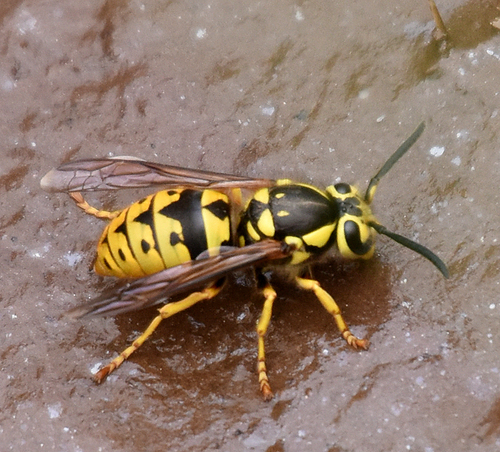
Western Yellowjacket
Vespula pensylvanica
The Western Yellowjacket is the bold architect of the backyard underground. Recognized by its striking yellow 'spectacles' and industrious nature, it is one of the most successful social insects in the American West.
Quick Identification
Size
Workers: 10–15 mm (0.4–0.6 in); Queens: up to 20 mm (0.8 in). Wingspan roughly 20–30 mm (0.8–1.2 in).
Colors
Bright yellow and black patterns. Both males and females feature alternating yellow and black bands on the abdomen, with the hallmark yellow ring completely encircling the eyes.
Key Features
- Complete yellow ring encircling the eyes
- Ground-nesting behavior
- Short, stocky body with a narrow 'wasp waist'
- Yellow and black abdominal bands with small black dots
When You’ll See Them
Behavior
The Western Yellowjacket is a highly social insect that lives in complex colonies. Unlike many other wasps that build paper nests high in trees, this species is primarily a ground-nester, often repurposing abandoned rodent burrows or finding voids in garden walls. Within the colony, a strict hierarchy exists with a single queen, many sterile female workers, and, late in the season, males and new queens. They are extremely industrious, spending their days foraging for both protein to feed the larvae and sugar to fuel their own flight.
While often feared for their sting, Western Yellowjackets are generally not aggressive toward humans unless their nest is disturbed or they feel threatened while competing for food. However, they are famous for 'crashing' outdoor meals in late summer. As their natural prey of caterpillars and flies becomes scarce in autumn, they switch to scavenging, which brings them into frequent contact with backyard barbecues and trash cans. During this time, the colony is at its largest and the individuals can become more persistent and protective of food sources.
EverydayEarth exclusive
Camera Tips
Capturing the Western Yellowjacket on camera requires a focus on 'micro-habitats.' Because they are ground-nesters, placing your camera 6 to 12 inches off the ground near a known foraging site is more effective than high-angle shots. Use a macro lens or a camera with a close focal point (within 1-3 feet) to resolve the intricate patterns on their abdomen. If your AI camera has a 'small animal' or 'insect' sensitivity setting, turn it to the highest level, as their rapid, zigzagging flight can sometimes fail to trigger sensors designed for larger mammals.
To attract them for a clear portrait, set up a 'feeding station' using a shallow dish. In early summer, use a small piece of deli meat or canned cat food to attract workers hunting for protein. In late summer and fall, switch to a sugar-based lure like a slice of overripe peach or a sponge soaked in sugar water. This will keep the wasp stationary long enough for the camera to focus. Ensure the bait is placed in a bright, sunlit area; yellowjackets are most active when it's warm, and the high shutter speed required to freeze their wing motion (over 1/1000th of a second) needs plenty of natural light.
Position your camera at a 45-degree side angle to the bait rather than directly overhead. This allows the AI to capture the profile view, which is essential for identifying the characteristic yellow eye-ring and the 'wasp waist.' If you find a nest entrance in the ground, do not place the camera directly over the hole, as this can trigger a defensive response. Instead, place it 3-5 feet away with a zoom lens to capture the high-traffic 'commuter' flight path without disturbing the colony. Always perform camera maintenance in the cool early morning hours when the wasps are less active and less likely to perceive you as a threat.
Similar Species
Species that look similar or are commonly confused with Western Yellowjacket.
German Yellowjacket
The German Yellowjacket has three tiny black dots on its face, whereas the Western Yellowjacket features a continuous yellow ring around the eyes.
Common Aerial Yellowjacket
Builds paper nests in trees or under eaves rather than in the ground, and has different abdominal marking patterns.
Frequently Asked Questions
Record Western Yellowjacket at your habitat
Connect a camera to start building your own species record — AI identifies every visitor automatically.