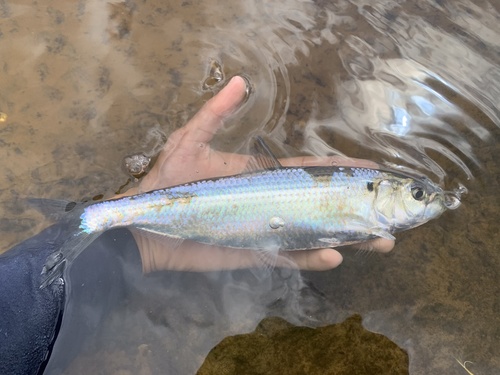
Blueback Shad
Alosa aestivalis
A shimmering marvel of the Atlantic, the Blueback Shad performs an incredible annual migration from the deep ocean to the heart of our coastal river systems.
Quick Identification
Size
Typically 25–30 cm (10–12 inches) long, reaching up to 40 cm (16 inches); weight usually ranges between 0.2–0.4 kg (0.5–1 lb).
Colors
Deep bluish-green or grayish-blue on the back, fading into bright iridescent silver on the sides and a white belly; a single small dark spot is located just behind the gill cover.
Key Features
- Deep blue-green dorsal coloration
- Single small dark spot behind the gill opening
- Slender, streamlined body with a deeply forked tail
- Peritoneum (lining of the body cavity) is usually black
When You’ll See Them
Geographic range
Where Does the Blueback Shad Live?
Native to the Atlantic coast of North America, the Blueback Shad occupies a vast stretch of the Eastern Seaboard. Its core range extends from the chilly waters of Nova Scotia and New Brunswick in Canada all the way south to the St. Johns River in Florida. While primarily a coastal marine resident that overwinters in deep offshore waters, it is a seasonal visitor to freshwater river systems throughout this coastal corridor. Landlocked populations have also been introduced to inland reservoirs and the Great Lakes, though these are outside their traditional migratory path.
Basemap © OpenStreetMap contributors
Behavior
Blueback Shad are anadromous fish, meaning they spend the majority of their adult lives in the saltwater of the Atlantic Ocean before migrating into freshwater rivers and coastal streams to spawn. They are highly gregarious and form tight-knit schools that move in unison, a defensive strategy that helps them evade larger predators like striped bass, bluefish, and ospreys. During their spring spawning runs, they are known for their energetic swimming and ability to navigate swift currents.
Unlike many other herring species that prefer quiet backwaters, Blueback Shad often choose swifter-moving sections of rivers with hard, rocky, or gravelly bottoms to deposit their eggs. After spawning, the adults return to the ocean, while the juveniles remain in the freshwater 'nurseries' for several months before heading out to sea in the late summer or autumn. Their relationship with humans is historically significant, as they were once a primary food and bait source for coastal communities, though they are now more often viewed through the lens of conservation and ecosystem health.
EverydayEarth exclusive
Camera Tips
Capturing the silver flash of Blueback Shad requires an underwater setup or a well-placed camera overlooking a shallow bottleneck. During the spring spawning run, position your camera in narrow river passages, near fish ladders, or over gravel bars where the fish congregate to spawn. Use a side-view angle approximately 12 inches above the riverbed to capture the full profile of the school as they fight the current.
Because these fish have highly reflective silver scales, lighting is your biggest challenge. Avoid placing cameras in areas with direct, overhead midday sun, which can cause 'white-out' glare on the fish's body. Early morning or late afternoon light provides a softer glow that highlights the distinct blue-green of their backs. If using an underwater housing, ensure the lens is positioned perpendicular to the water flow to prevent bubbles from obscuring the view.
Since Blueback Shad are fast, energetic swimmers, set your camera to a high frame rate (at least 60fps) to avoid motion blur. If using a motion-triggered trail camera near the water's edge, set the sensitivity to high; the shimmer of a passing school is often enough to trigger the sensor even if the fish themselves are submerged. Timing is everything: start your monitoring when local water temperatures reach 50°F (10°C), typically coinciding with the blooming of the 'shad bush' (Amelanchier) in the spring.
Similar Species
Species that look similar or are commonly confused with Blueback Shad.
Alewife
Almost identical, but the Alewife has a pale lining in its body cavity and typically spawns 3-4 weeks earlier in cooler water.
American Shad
Much larger than the Blueback Shad and usually features several dark spots along its side rather than just one.
Hickory Shad
Distinguished by a strongly projecting lower jaw that creates a 'pouty' appearance compared to the even jaws of the Blueback.
Frequently Asked Questions
Record Blueback Shad at your habitat
Connect a camera to start building your own species record — AI identifies every visitor automatically.