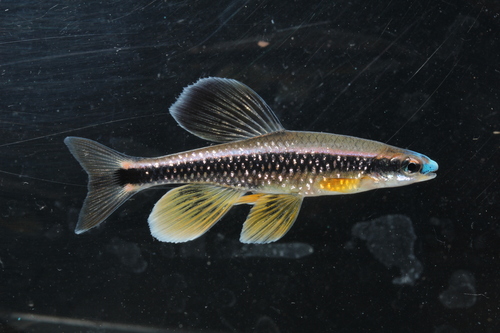
Bluenose Shiner
Pteronotropis welaka
Meet the 'Jewel of the South,' a tiny fish with a brilliant blue nose and sail-like fins that performs stunning underwater dances. Found in the quiet blackwater creeks of the Gulf Coast, this shiner is a master of color and courtship.
Quick Identification
Size
Small and slender, typically reaching 1.5 to 2.5 inches (3.8 to 6.4 cm) in length.
Colors
Breeding males feature a brilliant iridescent blue snout, dark metallic blue bodies, and yellow-orange fins. Females and non-breeding males are silvery-olive with a prominent dark lateral stripe.
Key Features
- Vivid iridescent blue snout on mature males
- Oversized, sail-like dorsal and anal fins
- Broad dark horizontal stripe running from nose to tail
- Deep-bodied compared to other minnows
When You’ll See Them
Geographic range
Where Does the Bluenose Shiner Live?
Native to the North American continent, the Bluenose Shiner is a localized treasure of the Southeastern United States. Its range is primarily restricted to the coastal plains, stretching from the St. Johns River drainage in Florida across to the Pearl River system in Mississippi, with significant populations found in the panhandle of Florida and parts of southern Georgia and Alabama. Because it requires very specific blackwater conditions, its distribution is patchy rather than continuous throughout this region.
Basemap © OpenStreetMap contributors
Behavior
The Bluenose Shiner is a schooling species that brings a flash of color to the slower-moving sections of coastal rivers. They are most famous for the spectacular courtship displays performed by males during the spring and summer. To attract mates and defend small territories, males flare their disproportionately large, sail-like fins and pulse their brilliant blue snouts, creating a shimmering effect in the tea-colored waters they call home.
These fish are generally peaceful and spend much of their time hovering in the mid-water column or seeking refuge near submerged vegetation and woody debris. Unlike many other shiners that prefer fast-moving riffles, the Bluenose Shiner is a specialist of deep, quiet pools where the current is minimal. They are social creatures, often found in mixed schools with other small minnow species, though they remain somewhat elusive and shy toward sudden movements above the water's surface.
EverydayEarth exclusive
Camera Tips
Capturing the Bluenose Shiner requires an underwater approach, as their subtle beauty is often lost when viewed from above the surface. For those with backyard creeks or shoreline access, using a waterproof action camera or a dedicated underwater trail camera is essential. Position the camera on a weighted base or a small tripod in a deep, slow-moving pool, ideally near a patch of aquatic weeds or a submerged log, which provides the cover these fish crave.
Because these fish live in 'blackwater'—which is stained like tea by tannins—lighting is your biggest challenge. Aim for a spot where sunlight penetrates the canopy and hits the water column between 10 AM and 2 PM. This natural 'spotlight' will catch the iridescence of the male's blue snout and the golden hues of their fins. If the water is particularly dark, using a camera with a high-quality sensor and setting it to a higher frame rate (60fps or more) can help capture the rapid flaring of their fins during displays.
To bring the school directly in front of your lens, you can use a small amount of finely crushed fish flakes or freeze-dried daphnia released slowly upstream. However, the best footage comes from patience during the spawning season (late spring to mid-summer), when males are naturally active and territorial. Set your camera to record in 2-3 minute intervals or use a motion-trigger if the water clarity allows for the AI to distinguish movement. Keep the lens clean and free of algae buildup for the best results.
Similar Species
Species that look similar or are commonly confused with Bluenose Shiner.
Frequently Asked Questions
Record Bluenose Shiner at your habitat
Connect a camera to start building your own species record — AI identifies every visitor automatically.