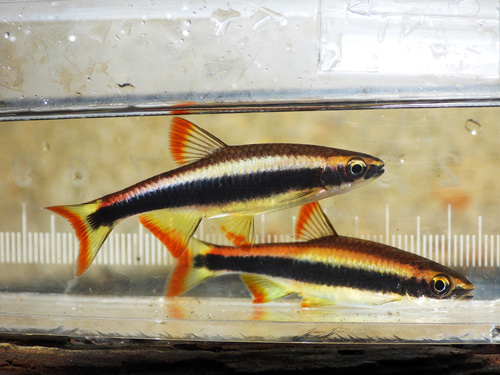
Flagfin Shiner
Pteronotropis signipinnis
The flagfin shiner is a living jewel of the Southeast, turning dark blackwater streams into a theater of vibrant orange and gold. With its oversized fins and energetic schooling behavior, it is a favorite for underwater backyard observers.
Quick Identification
Size
A small species reaching 1.5 to 2.5 inches (3.8 to 6.4 cm) in length.
Colors
Silver body with a broad, dark lateral stripe; fins are strikingly yellow to deep orange with prominent black margins.
Key Features
- Oversized, sail-like dorsal and anal fins
- Deep black lateral stripe ending in a dark spot at the tail base
- Bright orange or yellow fin coloration with black edging
- Slender, compressed silver body
When You’ll See Them
Geographic range
Where Does the Flagfin Shiner Live?
Native to the North American continent, the flagfin shiner is a specialist of the Southeastern United States coastal plain. Its core range extends through the Gulf Coast drainages, specifically from the Pearl River system in Mississippi eastward through Alabama and into the Panhandle of Florida. These fish are most concentrated in the tannic, 'tea-colored' waters of the Florida Panhandle and southern Alabama, where the specific water chemistry of blackwater streams supports their lifecycle.
Basemap © OpenStreetMap contributors
Behavior
The flagfin shiner is an energetic and social species that spends much of its time in small schools. Unlike some bottom-dwelling minnows, flagfins are active mid-water swimmers, constantly darting through the water column to investigate potential food sources. They are particularly known for their 'flashing' behavior, where the sunlight catches their vibrant fins as they turn sharply, making them look like tiny flags waving underwater.
During the breeding season, which typically occurs from late spring through summer, males become exceptionally territorial and vibrant. They will engage in elaborate displays, puffing out their large fins to intimidate rivals or attract females. While they are naturally shy around large disturbances, they are incredibly curious and will often investigate static objects—like an underwater camera—once they feel the environment is safe.
EverydayEarth exclusive
Camera Tips
To capture the stunning colors of the flagfin shiner, you will need an underwater camera setup, such as a waterproof action camera or a dedicated creek-cam. Placement is everything: position your camera in a slow-moving section of a creek, ideally near 'structure' like submerged logs or patches of aquatic grasses where the fish naturally congregate for cover. Angle the lens slightly upward toward the water's surface to catch the sunlight filtering through the canopy, which will make their orange fins pop against the dark water.
Lighting is the biggest challenge in the tannic, tea-colored water these fish prefer. For the best results, record during the middle of the day (10 AM to 2 PM) when the sun is directly overhead. The extra light penetrates the dark water better and illuminates the iridescent scales and deep orange hues of the fins. If the water is particularly dark, try to find a 'sun spot' in the creek where the canopy opens up.
You can encourage a school to hang out in front of your lens by using a small amount of 'bait' to simulate a natural insect fall. Crushing a few freeze-dried bloodworms or small fish flakes and releasing them just upstream of the camera can create a feeding frenzy that looks spectacular on video. Set your camera to a high frame rate (60fps or higher) because these fish move incredibly fast; slow-motion playback is often the only way to truly appreciate their fin-flicking displays.
Finally, patience is key. Flagfin shiners are wary of new objects. Place your camera and leave the area for at least 30 minutes. Once the school settles back into its routine, the fish will often swim within inches of the lens, providing high-detail shots of their unique 'flag' fins and the distinct black spot at the base of their tails.
Similar Species
Species that look similar or are commonly confused with Flagfin Shiner.
Frequently Asked Questions
Record Flagfin Shiner at your habitat
Connect a camera to start building your own species record — AI identifies every visitor automatically.