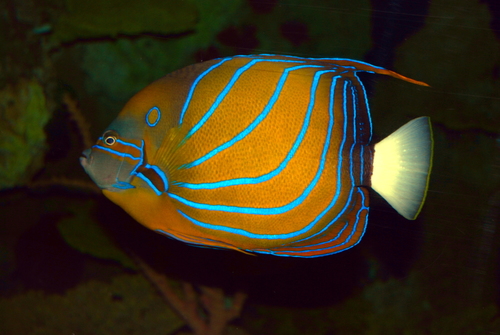
Bluering Angelfish
Pomacanthus annularis
With its electric blue stripes and royal golden-brown hue, the Bluering Angelfish is a master of the Indo-Pacific reefs. Known for its shy personality and iconic 'ring' marking, this stunning species is a top find for any underwater camera enthusiast.
Quick Identification
Size
Typically grows to 20-30 cm (8-12 inches), with a maximum length of 45 cm (18 inches)
Colors
Amber-brown body with 7-8 curved neon blue longitudinal stripes; a distinctive blue ring sits just behind the gill cover; tail is stark white.
Key Features
- Electric blue ring located behind the operculum (gill cover)
- 7-8 curved, glowing blue stripes on a golden-brown body
- White caudal (tail) fin with a yellow margin
- Heavy, deep-bodied oval shape typical of large angelfish
When You’ll See Them
Geographic range
Where Does the Bluering Angelfish Live?
The Bluering Angelfish is widely distributed across the tropical Indo-West Pacific region. Its range begins along the eastern coast of Africa and stretches across the Indian Ocean to the islands of Indonesia, the Philippines, and northern Australia. These fish are a common sight in the coral-rich waters of Southeast Asia and extend as far north as southern Japan and the Ryukyu Islands. While they are native to these warm saltwater environments, they have occasionally been reported as aquarium releases in Florida, though no permanent populations are established outside their native range.
Basemap © OpenStreetMap contributors
Behavior
The Bluering Angelfish is a regal but somewhat shy resident of the reef. Unlike some bolder species, it often seeks cover within caves or under large coral overhangs, especially during the brighter hours of the day. They are typically found living solitary lives or in monogamous pairs, patrolling a specific territory where they graze on the reef face. While they are peaceful toward most other fish, they can be highly territorial toward other large angelfish, often engaging in "barking" sounds—produced by their swim bladder—to warn off intruders.
In the wild, these fish are closely tied to the health of the reef. They are diurnal, meaning they are most active during daylight hours when they can clearly see their food sources. For humans, they are a prized sight for divers and snorkelers, though they generally maintain a respectful distance. Their movement is fluid and graceful, often tilting their bodies to pick at hard-to-reach crevices in the rockwork.
EverydayEarth exclusive
Camera Tips
To capture high-quality footage of a Bluering Angelfish, you must focus on the "edge" of the reef. Unlike some fish that swim in the open blue water, these angelfish hug the structure. Set your camera on a weighted tripod near a large sponge colony or a cleaning station—areas where smaller fish pick parasites off larger ones. This species is highly habitual, so if you see one dart into a cave, it will likely emerge from the same spot within 10 to 15 minutes.
Lighting is your biggest challenge underwater. If your camera is placed deeper than 5 meters, the red spectrum of light is lost, making the fish look dull and green. Use a camera with a high-quality red filter or, ideally, external video lights with a high CRI (Color Rendering Index) to make those neon blue stripes truly pop against their amber bodies. Positioning the lights at a 45-degree angle from the lens will help minimize "backscatter," which is when the light reflects off tiny particles in the water.
Because Bluering Angelfish are sensitive to sudden movements, an AI-powered trigger or a time-lapse setting is more effective than trying to follow them manually. Set your camera to a wide-angle focal length to capture their entire body as they cruise past. If you are placing a camera in a "backyard" coastal area or a dock, ensure the housing is treated with anti-fouling spray to prevent algae from clouding the lens over a long deployment.
Similar Species
Species that look similar or are commonly confused with Bluering Angelfish.
Frequently Asked Questions
Record Bluering Angelfish at your habitat
Connect a camera to start building your own species record — AI identifies every visitor automatically.