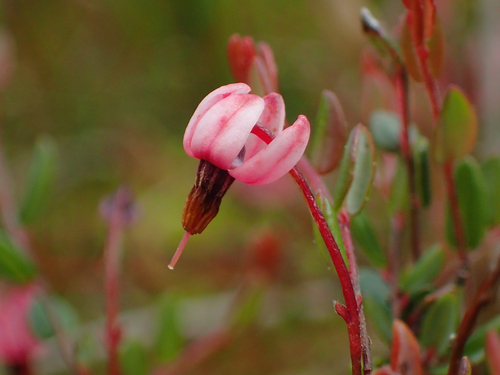
bog cranberry
Vaccinium oxycoccos
A tiny but mighty survivor of the northern wetlands, the bog cranberry paints acidic peatlands with delicate pink blooms and iconic tart red fruit.
Quick Identification
Size
Prostrate stems 10–20 cm (4–8 in) long; berries 6–12 mm (0.2–0.5 in) in diameter
Colors
Bright red berries, deep pink to rose-colored flowers, dark green evergreen leaves with silvery undersides
Key Features
- Creeping, wiry stems that trail across moss
- Tiny, pointed evergreen leaves with edges rolled inward
- Flowers with four strongly reflexed (peeled back) pink petals
- Small, tart red berries often speckled when young
When You’ll See Them
Behavior
The bog cranberry is a resilient, low-growing evergreen shrub that spends its life hugging the damp, acidic surfaces of peat bogs. Unlike many garden plants, it has a symbiotic relationship with mycorrhizal fungi, which help it absorb nutrients in the nitrogen-poor, waterlogged soils where it thrives. It grows slowly, spreading via thin, woody runners that weave through cushions of sphagnum moss.
During the late spring and early summer, the bog cranberry produces delicate, nodding flowers that resemble the head and neck of a crane—the origin of the name 'crane-berry.' These flowers are primarily pollinated by bumblebees and other hardy insects capable of 'buzz pollination.' Once pollinated, the plant focuses its energy on developing its signature tart fruit, which remains on the vine well into winter, providing a vital late-season food source for various wildlife.
For humans, the bog cranberry is a seasonal treasure. While the berries are quite acidic and tart when raw, they become sweeter after the first frost breaks down some of the complex starches. Because they grow in fragile bog ecosystems, they are often overlooked by casual hikers, but they play a critical role in the biodiversity of northern wetlands.
EverydayEarth exclusive
Camera Tips
Capturing the bog cranberry on a backyard or trail camera requires a 'macro' mindset. Because these plants grow only a few inches off the ground, you should mount your camera on a low-profile stake or even a flat stone directly at moss level. Aim the lens horizontally across the top of the sphagnum moss to capture the profile of the nodding pink flowers or the clusters of bright red berries. A downward-angled shot can also work well to show the 'carpet' effect of the vines.
If you are using an AI-powered camera to detect wildlife interacting with the plant, place your setup near a healthy patch of berries in late autumn. This is when you are most likely to film birds like grouse, cedar waxwings, or even small mammals like voles and mice foraging on the fruit. The red of the berries provides a high-contrast trigger for many motion sensors, especially against the brown or green background of a bog.
For the best visual results, focus on the 'Golden Hour' (shortly after sunrise or before sunset). The low sun angle highlights the dew on the berries and the delicate texture of the evergreen leaves. If your camera has a time-lapse mode, bog cranberries are excellent subjects for a multi-month project; start in June to capture the blooming flowers and continue through the first frost to see the berries turn from pale green to deep, ruby red.
Be mindful of the environment when placing your camera. Bogs are incredibly fragile ecosystems; avoid trampling the moss around the plants. Use a wide-angle lens if possible to capture the cranberry in its wider habitat, which often includes carnivorous plants like pitcher plants or sundews that share the same acidic conditions.
Similar Species
Species that look similar or are commonly confused with bog cranberry.
Frequently Asked Questions
Record bog cranberry at your habitat
Connect a camera to start building your own species record — AI identifies every visitor automatically.