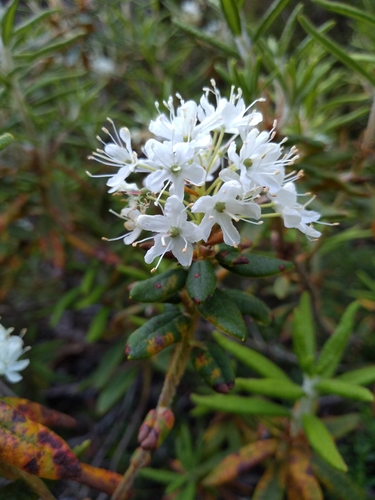
Bog Labrador Tea
Rhododendron groenlandicum
A fragrant staple of the northern wilderness, Bog Labrador Tea is celebrated for its snowy white summer blooms and its unique, rusty-orange woolly leaves. This hardy evergreen shrub is a testament to nature's ability to thrive in the harshest, most acidic wetlands on the planet.
Quick Identification
Size
Height ranges from 0.2 to 1.5 meters (0.6 to 5 feet) with a spreading width up to 1 meter (3.3 feet)
Colors
Leathery dark green upper leaves; distinctive rusty-orange or woolly white undersides; snowy white flower clusters
Key Features
- Leathery evergreen leaves with edges rolled tightly inward
- Underside of leaves covered in thick, rusty-orange or white fuzz
- Fragrant hemispherical clusters of small white five-petaled flowers
- Low, dense growth habit typically found in spongy peat moss
When You’ll See Them
Geographic range
Where Does the Bog Labrador Tea Live?
This resilient shrub is a quintessential species of the northern hemisphere's wild places, primarily native to the vast boreal regions of North America. Its range spans the continent from the rugged coasts of Alaska and the Pacific Northwest, across the entirety of Canada to Newfoundland, and reaches southward into the Great Lakes region and the northeastern United States. Beyond the mainland, it is also a characteristic feature of the coastal barrens and damp valleys of Greenland, thriving where few other woody plants can survive.
Basemap © OpenStreetMap contributors
Behavior
During the flowering season in late spring and early summer, the shrub becomes a focal point for local biodiversity. Its fragrant white blossoms produce copious amounts of nectar, attracting a wide variety of pollinators including bumblebees, butterflies, and hoverflies. While the plant is slow-growing, it is incredibly long-lived, often forming dense, aromatic thickets that provide essential ground cover for small mammals and nesting birds in open bog landscapes.
EverydayEarth exclusive
Camera Tips
For users of AI-powered backyard cameras, the flowering period in June and July is the 'golden window.' The bright white flower clusters provide excellent contrast against the dark green foliage, making it easier for AI models to detect and trigger when pollinators like the Western Tiger Swallowtail or various bumblebee species land on the blooms. If your camera has a macro setting or a close-focal lens, use it here to capture the intricate detail of the stamens protruding from the flowers.
Don't overlook the winter season for this species. Since Bog Labrador Tea is evergreen, it provides a rare pop of color in a snowy landscape. A time-lapse setting, taking one photo every hour during a snowstorm, can produce a stunning video of the snow accumulating on the leathery leaves. Additionally, because these thickets offer warmth and protection, aim your camera at the base of the shrub during the winter months to catch glimpses of snowshoe hares or voles that frequently use the plant as a natural shelter.
Similar Species
Species that look similar or are commonly confused with Bog Labrador Tea.
Frequently Asked Questions
Record Bog Labrador Tea at your habitat
Connect a camera to start building your own species record — AI identifies every visitor automatically.