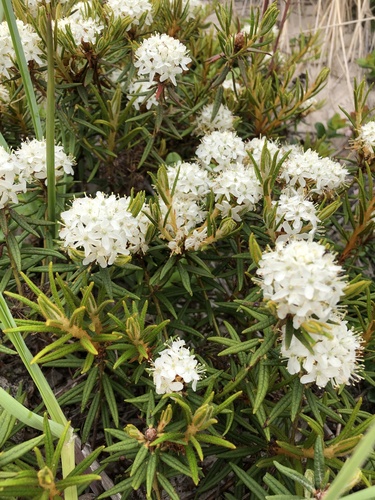
marsh Labrador tea
Rhododendron tomentosum
A fragrant staple of the northern muskeg, marsh Labrador tea charms with its clusters of snowy white blossoms and unique rusty-orange foliage. This hardy evergreen shrub is a master of survival in the harshest, soggiest environments on Earth.
Quick Identification
Size
A low-growing shrub typically reaching 0.5–1 meter (1.6–3.3 feet) in height with a similar spread.
Colors
Leathery dark green upper leaves; distinctive rusty orange-brown fuzzy undersides; clusters of small, five-petaled white flowers.
Key Features
- Narrow, evergreen leaves with downward-curled edges
- Dense, rusty-brown woolly fuzz on the underside of leaves
- Spherical clusters of fragrant white flowers with long stamens
- Pungent, spicy aroma when leaves are crushed or handled
When You’ll See Them
Behavior
Marsh Labrador tea is a resilient, slow-growing evergreen shrub that defines many northern wetland ecosystems. While it doesn't move like the animals we usually track, it exhibits fascinating seasonal "behaviors" such as leaf drooping in extreme cold to conserve moisture and a dramatic flowering period in early summer. It is a vital member of the peat bog community, often forming dense thickets that provide shelter for small mammals and nesting sites for ground-dwelling birds.
For humans, this plant has a long history of traditional use as a medicinal tea and an insect repellent, though it contains varying levels of ledol, which can be toxic in high concentrations. In the garden or the wild, it acts as a primary nectar source for early-season pollinators, creating a hub of activity in otherwise quiet, acidic marshlands. Its aromatic oils are a defense mechanism against herbivores, though it remains a favorite haunt for specialized bog-dwelling insects.
EverydayEarth exclusive
Camera Tips
Capturing the beauty of marsh Labrador tea requires a different approach than tracking mobile wildlife. To document its life cycle, set your camera to time-lapse mode rather than motion-trigger. Position the camera on a sturdy stake at a low height—roughly 15 to 20 inches from the ground—to get a "pollinator’s eye view" of the flower clusters. A downward angle of about 30 degrees works best to show both the snowy white blossoms and the dark green foliage simultaneously.
The most distinctive feature of this species is the "tomentum," the rusty orange fuzz on the leaf undersides. To capture this on camera, place your device close enough (check your camera's minimum focal distance) to see the edges of the leaves where they curl under. Using a camera with a macro setting or a high-resolution sensor will allow you to crop in on these textures. Early morning light is particularly magical for this plant, as dew drops often cling to the woolly leaf hairs, creating a sparkling effect in the first hour of sunlight.
If you are interested in the wildlife that visits the plant, set your motion sensitivity to its highest level during the peak blooming weeks of June and July. The fragrant flowers attract a variety of butterflies, hoverflies, and bees. Because these shrubs grow in soft, boggy ground, ensure your camera mount is deeply anchored; otherwise, the freezing and thawing of the wet soil can cause the camera to tilt over time. If your camera supports it, use a 4K video setting to capture the subtle swaying of the flowers in the wind, which adds a professional cinematic feel to your backyard observations.
Similar Species
Species that look similar or are commonly confused with marsh Labrador tea.
Frequently Asked Questions
Record marsh Labrador tea at your habitat
Connect a camera to start building your own species record — AI identifies every visitor automatically.