Bongo
Tragelaphus eurycerus
The Bongo is the ultimate prize for wildlife observers—a massive, striped 'forest ghost' that haunts the deepest jungles of Africa. With its spiraling horns and vivid chestnut coat, it is widely considered one of the most beautiful large mammals on Earth.
Quick Identification
Size
Length: 215-315 cm (7.1-10.3 ft); Shoulder Height: 110-130 cm (3.6-4.3 ft); Weight: 210-405 kg (460-890 lbs)
Colors
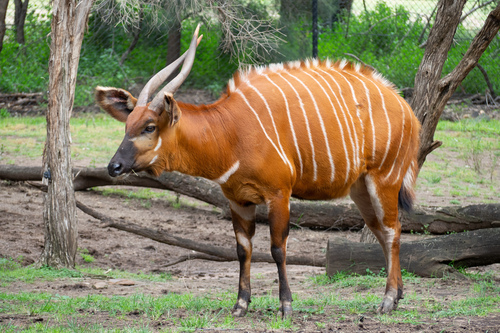
Vibrant reddish-brown or chestnut coat with 10-15 vertical white stripes; white chevron between the eyes and white cheek spots; dark legs with white bands.
Key Features
- 10-15 thin vertical white stripes on a chestnut body
- Heavy, lyre-shaped spiraled horns present in both sexes
- Large, rounded ears for detecting movement in dense brush
- Striking white 'V' shaped chevron marking between the eyes
When You’ll See Them
Geographic range
Where Does the Bongo Live?
The Bongo is a resident of the lush heart of sub-Saharan Africa, with its primary population concentrated in the humid lowland forests of the Congo Basin and West Africa. This includes core ranges in Gabon, Cameroon, and the Central African Republic, while a critically endangered and isolated subspecies survives in the high-altitude mountain forests of Kenya, specifically within the Aberdare Mountains and Mount Kenya regions. They are specialists of the deep jungle, rarely venturing far from the protection of dense overhead canopy.
Basemap © OpenStreetMap contributors
Behavior
The Bongo is a master of the deep forest, using its vivid stripes to break up its silhouette against the dappled light of the jungle. Unlike many other large antelope, Bongos are shy and reclusive, primarily active during the night or the dim hours of dawn and dusk to avoid predators. They are one of the few species where both males and females grow horns, which they use to navigate through dense vines by tilting their heads back so the horns lay flat against their spines.
Socially, Bongos are flexible; females often live in small groups of five to twenty individuals, while older bulls are typically solitary. They have a fascinating dependency on mineral licks and are known to visit these clearings to consume salt-rich soil or charcoal from trees struck by lightning. Their interactions with humans are incredibly limited due to their preference for nearly impenetrable forest mosaics, earning them a reputation as the 'ghosts' of the African rainforest.
EverydayEarth exclusive
Camera Tips
To capture the elusive Bongo on a trail camera, your most effective strategy is to locate a natural mineral lick or 'saline' in the forest. These are areas where the soil is rich in salts, and Bongos will travel miles to visit them, often under the cover of darkness. Position your camera at the edge of these clearings, roughly 1.2 metres (4 feet) high. Because Bongos are the third-largest antelope in the world, ensure the camera is set back at least 6 metres (20 feet) from the center of the lick to ensure you capture the full animal and not just a blur of orange fur.
Lighting is critical in the dark forest understory. Use a 'No-Glow' or 'Black Flash' infrared camera to ensure the flash doesn't spook the animal, as Bongos are notoriously skittish and may avoid a location for weeks if they feel threatened. Set your camera to video mode with 20-second clips; this allows you to see their social interactions and hear the distinct vocalizations or the sound of their horns clashing against the brush. High-speed SD cards are a must, as these animals often move quickly through the frame when they aren't feeding.
Due to the high humidity and heavy rainfall in Bongo territory, always use a waterproof security box and a moisture-absorbing desiccant pack inside the camera housing to prevent lens fogging. Scent control is also paramount—wipe down your equipment with a scent-neutralizing spray and wear gloves when handling the camera. If you are tracking the rare Mountain Bongo in Kenya, focus your efforts on bamboo thickets near water sources during the transition between the wet and dry seasons.
Similar Species
Species that look similar or are commonly confused with Bongo.
Frequently Asked Questions
Record Bongo at your habitat
Connect a camera to start building your own species record — AI identifies every visitor automatically.