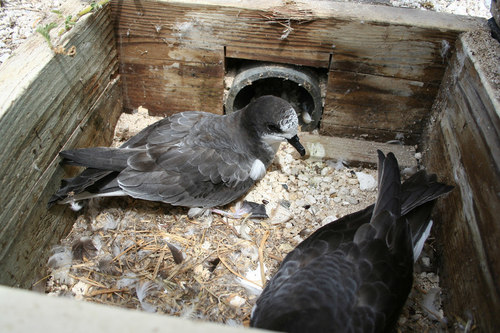
Bonin Petrel
Pterodroma hypoleuca
A phantom of the North Pacific, the Bonin Petrel is a master of the night and a champion of the open sea. Known for its distinctive 'M' wing markings and secretive burrowing habits, this resilient seabird is a rare treat for any wildlife observer.
Quick Identification
Size
Length: 29–31 cm (11.5–12.2 in); Wingspan: 63–71 cm (25–28 in); Weight: 160–200 g (5.6–7 oz)
Colors
Pale grey upperparts with a dark 'M' pattern across wings; white underparts; white face with a dark cap and mask through the eyes.
Key Features
- Distinctive dark 'M' or 'W' pattern across the upper wings
- Small, thick black bill
- Mostly white underwings with thin dark borders
- White forehead contrasting with a dark crown
When You’ll See Them
Geographic range
Where Does the Bonin Petrel Live?
Native to the vast expanses of the North Pacific Ocean, the Bonin Petrel primarily breeds on remote islands in the Northwestern Hawaiian chain, including Midway Atoll, Laysan, and Lisianski. It also maintains significant breeding colonies on Japan's Ogasawara (Bonin) and Volcano Islands. During the non-breeding season, these birds range widely across the subtropical and temperate Northwest Pacific, frequently appearing in the waters off the coast of Japan and occasionally wandering toward the Aleutian Islands. They are almost exclusively found in deep marine environments, only making landfall to raise their young on isolated, predator-free islands.
Basemap © OpenStreetMap contributors
Behavior
The Bonin Petrel, known in Hawaii as the 'nunulu' (meaning 'moaning' or 'grumbling'), is a highly secretive seabird that spends the majority of its life at sea. On their breeding islands, they are strictly nocturnal, arriving at their colonies well after sunset and departing before dawn. This behavior is an evolutionary tactic to avoid predation by larger, more aggressive birds like Great Frigatebirds or hawks. They are social nesters, often forming vast colonies where thousands of pairs dig deep burrows in the sandy soil.
When flying over the open ocean, the Bonin Petrel exhibits the classic 'gadfly petrel' flight style—a series of high, rapid arcs and erratic banking maneuvers that allow them to cover massive distances with minimal effort. They are relatively indifferent to human presence on their remote breeding islands, though they are highly sensitive to artificial light, which can cause them to become disoriented and 'fall out' from the sky.
EverydayEarth exclusive
Camera Tips
Capturing the Bonin Petrel on camera is a unique challenge because they are almost never seen on land during the day. If you are lucky enough to live near or visit a breeding colony, your camera must have high-quality infrared (IR) night vision or 'No-Glow' LEDs. Because these birds nest in burrows, the best placement for an AI-powered camera is approximately 2-3 feet off the ground, angled downward toward a known burrow entrance. Ensure the camera is positioned at least 5-6 feet away from the hole to maintain a wide field of view, as the birds often land clumsily and scramble several feet before entering their homes.
Do not use white-light flashes, as this will blind and distress the birds, potentially causing them to abandon their nests or become easy targets for predators. Set your camera's trigger speed to the fastest possible setting; despite their name, 'gadfly' petrels move with incredible speed and can zip in and out of the frame in less than a second. If your camera supports video, short 10-15 second clips are often more rewarding than photos, as they capture the bird’s unique 'shuffling' walk and the eerie moaning vocalizations they make from inside the burrows.
If you are trying to capture them in a maritime or coastal environment, remember that salt spray is the enemy of electronics. Use a waterproof housing and wipe the lens frequently with a microfiber cloth. While they are not typical 'backyard' birds in the suburban sense, those on island properties can attract them simply by maintaining dark-sky-friendly lighting and ensuring the soil is stable enough for burrowing without being compacted by foot traffic or heavy machinery.
Similar Species
Species that look similar or are commonly confused with Bonin Petrel.
Mottled Petrel
Larger with a prominent dark grey belly patch; the Bonin Petrel is smaller with a clean white belly.
Cook's Petrel
Lacks the dark underwing borders seen on the Bonin Petrel and has a much paler grey crown.
Black-winged Petrel
Has much bolder, thicker black margins on the underside of the wings compared to the Bonin Petrel's thin borders.
Frequently Asked Questions
Record Bonin Petrel at your habitat
Connect a camera to start building your own species record — AI identifies every visitor automatically.