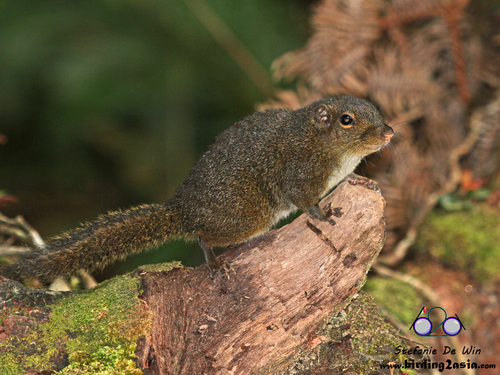
Bornean Mountain Ground Squirrel
Sundasciurus everetti
A sturdy, ground-dwelling specialist of Borneo's misty peaks, the Bornean Mountain Ground Squirrel is the unsung engineer of the cloud forest floor.
Quick Identification
Size
Head-body length 17–20 cm (6.7–7.9 in), tail length 11–15 cm (4.3–5.9 in), weighing approximately 170–250g (6–8.8 oz)
Colors
Dull olive-brown upperparts with fine buff speckling; underparts are pale grey to buffy-white; distinct pale eye-rings
Key Features
- Relatively short, bushy tail (shorter than the body)
- Distinctive pale buff ring around each eye
- Primarily ground-dwelling posture with sturdy limbs
- Uniform olive-brown coat without stripes or spots
When You’ll See Them
Geographic range
Where Does the Bornean Mountain Ground Squirrel Live?
Native to the island of Borneo, this species is a true specialist of the clouds. It is found exclusively in the high-elevation mountain ranges that form the rugged spine of the island, spanning the Malaysian states of Sabah and Sarawak, as well as the Indonesian province of North Kalimantan. It is most frequently documented in the protected highlands of Mount Kinabalu and the Crocker Range, where the cool, misty climate provides its ideal environment.
Basemap © OpenStreetMap contributors
Behavior
The Bornean Mountain Ground Squirrel is notably more terrestrial than its cousins in the Sundasciurus genus. While most squirrels are synonymous with canopy acrobatics, this species spends the majority of its daylight hours scurrying across the forest floor, navigating the complex matrix of moss, fallen logs, and leaf litter characteristic of Borneo's high-altitude forests.
They are generally solitary foragers, though they can occasionally be seen in pairs. Their social structure is relatively under-studied, but they appear to be non-aggressive toward humans, typically freezing or retreating into dense undergrowth when startled. Unlike the high-pitched chatter of lowland squirrels, their vocalizations are often more subtle, suited for the damp, sound-muffling environments of the cloud forest.
EverydayEarth exclusive
Camera Tips
Capturing the Bornean Mountain Ground Squirrel requires a ground-level approach. Because this species rarely ventures into the canopy, you should position your camera no higher than 15 to 30 centimeters (6–12 inches) off the ground. Aiming the lens toward a natural clearing in the leaf litter or along the side of a moss-covered log—which they often use as 'highways'—will significantly increase your capture rate.
Since these squirrels live in high-humidity, high-rainfall environments, ensure your camera housing is rated for extreme moisture. Use a desiccant pack inside the battery compartment to prevent lens fogging, which is the most common cause of failed shots in the Bornean highlands. A camera with a fast trigger speed (0.3 seconds or less) is essential, as these rodents are quick and erratic in their movements.
While we recommend observing natural behavior, if you are struggling to get a sighting, a small handful of native oil palm fruit or crushed nuts placed near a fallen log can serve as an effective lure. Position the bait about 2-3 meters from the camera to ensure the squirrel is within the focal range. Set your camera to 'Burst Mode' or 'Photo + Video' to capture both the identifying markings and their unique ground-scurrying gait.
Similar Species
Species that look similar or are commonly confused with Bornean Mountain Ground Squirrel.
Frequently Asked Questions
Record Bornean Mountain Ground Squirrel at your habitat
Connect a camera to start building your own species record — AI identifies every visitor automatically.