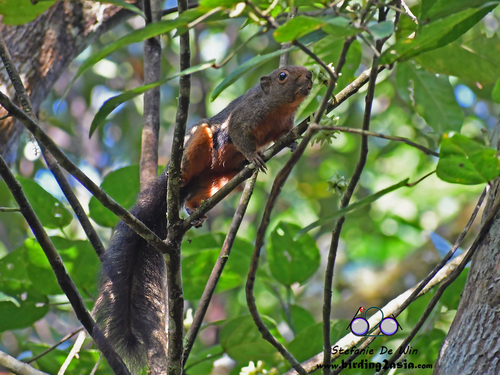
Kinabalu Squirrel
Callosciurus baluensis
A vibrant highland specialist, the Kinabalu Squirrel is a jewel of the Bornean mountains, known for its fiery orange belly and distinctive racing stripes. Endemic to the mist-shrouded forests of Sabah, this charismatic rodent is a favorite among trekkers and wildlife photographers alike.
Quick Identification
Size
Total length 35-45 cm (14-18 in); body 20-24 cm (8-9.5 in); weight 250-400 g (9-14 oz)
Colors
Grizzled blackish-grey upperparts, vibrant reddish-orange underparts, and distinctive flank stripes consisting of a thin buff line above a broader black line.
Key Features
- Reddish-orange underparts contrasting with dark back
- Thin buff side stripe over a broader black stripe
- Grizzled blackish-grey tail and upper body
- Bushy, dark tail often held in a curve
When You’ll See Them
Geographic range
Where Does the Kinabalu Squirrel Live?
This striking rodent is native to the island of Borneo, specifically the highland regions of East Malaysia in the state of Sabah. While its name highlights Mount Kinabalu, its core range extends throughout the Crocker Range and other mountainous areas of northern Borneo. It is a true island endemic, found nowhere else on Earth, thriving in the cool, moist climates of the Southeast Asian mountain spine.
Basemap © OpenStreetMap contributors
Behavior
The Kinabalu Squirrel is a high-altitude specialist that brings a splash of color to the misty montane forests of Borneo. These squirrels are primarily arboreal, spending much of their time navigating the mossy branches of oak and chestnut trees, though they are notably more willing to descend to the lower canopy and forest floor than some of their lowland relatives. They are active during the day, using their keen eyesight to spot both food and potential predators like eagles or martens.
While they are generally solitary or seen in pairs, they are highly vocal. Their chattering calls often echo through the highlands, serving as territorial markers or alarm signals. To humans, they are often seen as bold and inquisitive, particularly near park headquarters or mountain trailheads where they have become accustomed to the presence of hikers, though they remain wild and cautious in more remote areas of the Crocker Range.
EverydayEarth exclusive
Camera Tips
Capturing the Kinabalu Squirrel on camera requires focusing on the vertical transitions between the canopy and the forest floor. Since these squirrels are frequently active in the mid-story and on mossy logs, mount your AI camera at chest height (about 4-5 feet) on a tree with visible lichen or moss growth. Angling the camera slightly downward toward a flat branch or a fallen log that acts as a natural 'bridge' will increase your chances of capturing a clear profile shot of their distinctive flank stripes.
While we don't recommend feeding wild animals, placing your camera near native fruiting trees like highland figs or oak trees dropping acorns will naturally attract them. They are most active in the mid-morning when the mountain mist begins to clear and the sun warms the bark. Ensure your camera's trigger speed is set to its fastest setting, as like most Callosciurus species, they move in quick, jerky bursts and can easily blur a slow shot.
During the monsoon season (October to February), the heavy rains can cause false triggers. Use a protective housing to keep the lens clear of tropical condensation. If you are setting up near a highland garden or lodge, look for 'travel corridors' where squirrels jump from the forest edge to man-made structures; these predictable paths are goldmines for high-quality, close-up footage of their vibrant orange bellies.
Similar Species
Species that look similar or are commonly confused with Kinabalu Squirrel.
Frequently Asked Questions
Record Kinabalu Squirrel at your habitat
Connect a camera to start building your own species record — AI identifies every visitor automatically.